
What if the biggest threat to your shop's success isn't a slow Tuesday or a missing stylist, but the 3.5% you're quietly handing over to your credit card processor on every single transaction? After 30 years in the beauty industry and 20 years behind the owner's desk, I've seen too many talented pros work themselves to the bone only to finish the year with a thin 10% profit margin. It's a common story in 2026. You're busy, your clients are happy, but your beauty salon financial health is suffering because of "convenience" fees and fragmented software that feels like it's working against you.
I know exactly how it feels to stare at a monthly processing statement showing percentages like 2.6% plus ten cents gone from every haircut, or similar fees taking 2.9% plus thirty cents for every online booking. You deserve to keep that money. In this guide, I'm sharing the exact checklist I use to help owners reclaim their revenue and stop the seasonal cash flow roller coaster. We'll walk through a 10-minute weekly financial pulse check and show you how to integrate your booking and payments so they finally play nice together. It's time to stop the leaks and start growing your business with the clarity you've been looking for.
Key Takeaways
- Shift your focus from vanity metrics like total sales to the actual margins that define your beauty salon financial health.
- Learn how to implement a Cash Discount Program to stop the "convenience fee" drain and keep thousands of dollars in your pocket each year.
- Use the 15.24 Rent Rule and the "Clear Bucket" backbar audit to quickly spot hidden overhead costs that are eating your profit.
- Discover why integrating your booking and payments through a unified system like Clover eliminates the "time-thief" of manual spreadsheets.
- Transition from daily survival to strategic expansion by applying veteran-tested wisdom to your 2026 growth plan.
The Reality of Beauty Salon Financial Health in 2026
I've spent 30 years in the beauty industry, and 20 of those were spent in the trenches as a salon owner. If there's one thing I've learned, it's that a packed lobby doesn't always mean a full bank account. I've seen talented owners close their doors simply because they mistook "being busy" for "being profitable." In 2026, "busy" is nothing more than a vanity metric. Your true beauty salon financial health is found in your margins, not your total deposits. We need to have a neighborly chat about the "Busy-But-Broke" syndrome that shows up on far too many P&L statements this year. It's a quiet killer, but we can fix it without you needing an MBA.
Revenue vs. Profit: The Distinction That Saves Businesses
Your "take-home" truth is what's left after you pay the stylists, the landlord, and the color house. According to the State of the Salon Industry, hair services still drive about 55% of total revenue. However, your artistic talent can actually become a liability if you don't have a financial framework to protect it. I've met owners who are world-class colorists but don't know their precise break-even point. There's an incredible emotional relief that comes from knowing exactly how many sets of highlights you need to sell to cover your overhead. Once you hit that number, every dollar after that is yours to keep. Without that clarity, you're just guessing and hoping for the best.
Red Flags: When Your Salon is Faking Health
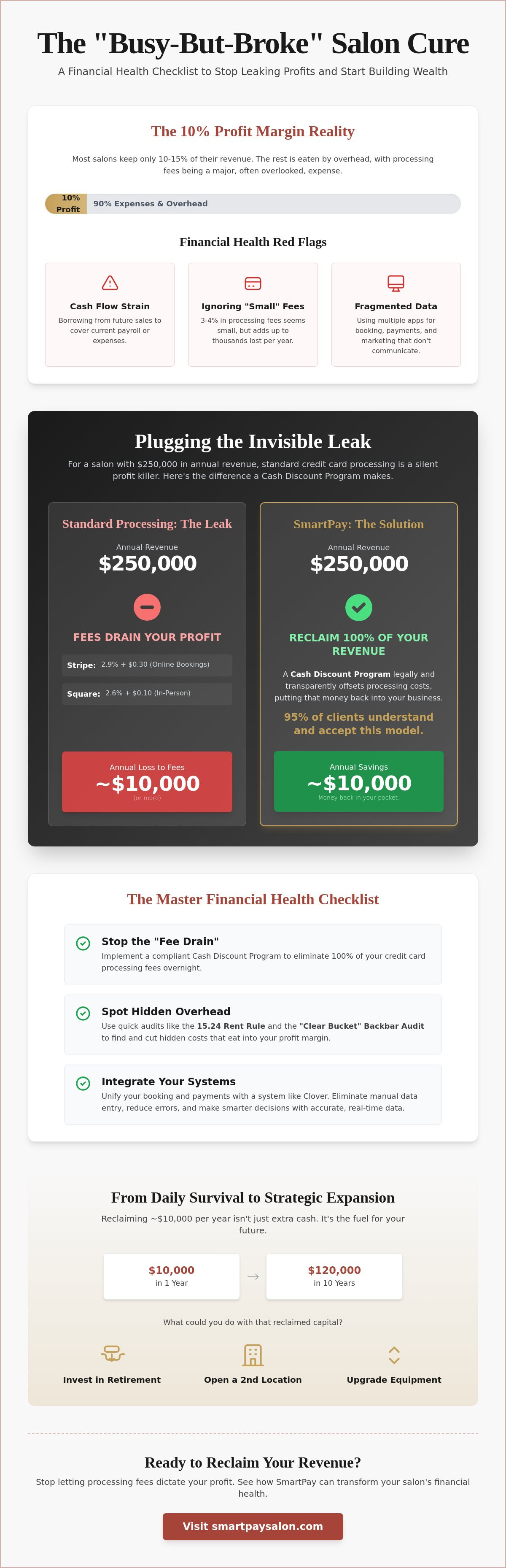
Diagnosing your beauty salon financial health starts with spotting the warning signs before they become disasters. If you're borrowing from next week's retail sales to cover this week's payroll, you're in trouble. It's a common trap. Another red flag is ignoring those "small" transaction fees. In May 2026, Square charges 2.6% plus $0.10 for in-person sales, while Stripe takes 2.9% plus $0.30 for online bookings. Those dimes and quarters add up to the cost of a family vacation by December. Finally, look at your data. If you're juggling three different apps that don't talk to each other, your information is fragmented. You can't make smart decisions with broken data. Stop the chaos and start looking at the real numbers.
- The 10% Reality: Average salon profit margins currently sit between 10% and 15%.
- The Fee Drain: Processing fees often eat 3% to 4% of total revenue if left unmanaged.
- The Data Gap: 55% of salons are moving toward AI-powered systems to fix fragmented scheduling.
Plugging the Invisible Leak: The Processing Fee Cure
Stop letting generic processors dictate your take-home pay. Manage your costs by looking closely at what I call the "Stripe Headache." In May 2026, Stripe's 2.9% plus $0.30 fee on every online booking isn't just a convenience charge; it's a persistent leak in your beauty salon financial health. When you're processing $250,000 a year, which is the current U.S. average revenue for a salon, you're losing nearly $10,000 annually to these flat-rate giants. That is money that belongs in your pocket, not theirs.
Imagine what an extra $1,000 every month could do for your long-term stability. That isn't just "extra" money. Over a decade, that's $120,000 toward your retirement fund or the seed money for a second location. A Cash Discount Program is a legal, compliant way to reclaim 100% of your processing costs. By shifting the cost of the transaction to the payment method rather than the salon owner, you effectively eliminate one of your largest monthly overhead expenses overnight.
The Psychology of the Cash Discount
I often tell my neighbors in the industry that clients actually appreciate transparency. You don't have to sound "cheap" or pushy when you talk about your bottom line. When you explain that a Cash Discount Program helps you keep service prices stable while supporting local stylists, 95% of your clients won't mind the small adjustment. It's all about the delivery. Think of it like a QVC host sharing a helpful tip: you're simply offering a reward to those who help you keep the salon's costs down. It’s a "small business support" model that resonates with today's community-focused consumers.
Compliance and Transparency
You must do this the right way to protect your reputation and your legal standing. Effective Small Business Financial Management requires staying 100% compliant with signage and POS configurations. There is a vital technical difference between a "surcharge" and a "cash discount." A surcharge can feel like a penalty to your clients, while a cash discount feels like a benefit. We handle the technical heavy lifting and all the compliance hurdles at SmartPay so you can stay focused on the artistry happening at the chair. If you're ready to stop the invisible leak, we can help with a custom merchant account setup that prioritizes your beauty salon financial health and puts you back in control of your margins.
The Master Financial Health Checklist for Salon Owners
I like to start my Saturday mornings with a quiet cup of coffee and a 10-minute review of the books before the first blow-dryer starts humming. It’s a simple ritual that keeps me from flying blind. Monitoring your beauty salon financial health shouldn't feel like a chore or a math test. Think of it as a quick check-up to make sure your hard work is actually staying in your pocket. I’ve developed a master checklist over the last 20 years that cuts through the noise and focuses on the numbers that truly move the needle for a small shop.
First, let’s talk about the 15.24 Rent Rule. It’s a simple way to see if you’re working for yourself or just working for your landlord. Ideally, your rent should stay under 15% of your total gross revenue, or 24% of your service revenue alone. If you’re paying more than that, you're "house poor," and it’s very hard to out-style a bad lease. Next, take a look at your backbar. I use the "Clear Bucket" strategy. Every time a stylist throws away a half-used tube of color or a soaked neck strip, it goes into a clear bin for one week. Seeing that physical waste is a wake-up call that often reveals hundreds of dollars in lost profit sitting right in the trash.
A healthy salon in 2026 should also aim for a 20% retail-to-service ratio. While hair services drive about 55% of revenue, your retail sales are your highest-margin products. If your retail is lagging, your overall beauty salon financial health is likely taking a hit. While we’ve already discussed plugging the big leaks like merchant fees, Understanding Processing Fees and other hidden costs is a continuous part of this weekly audit. You can't manage what you don't measure.
Labor and Commission Structures
Is your commission structure killing your growth? I’ve seen owners offer 60% or 70% just to keep a "top" stylist, only to realize that after taxes and backbar costs, the salon is actually losing money on every one of that stylist's clients. Shift to an "Incentive Goal" model. This protects your base margins while rewarding stylists for hitting specific targets in retail or pre-booking. It turns your team into partners in your success rather than just tenants at a station.
Fixed Cost Audits: The 'House Poor' Trap
Subscription fatigue is real. Audit your software every quarter to see what you're actually using. I once found I was paying for three different "re-engagement" tools that did the exact same thing. Beyond software, watch your utilities. High-frequency laundry and old water heaters can quietly add $200 a month to your overhead. My best advice for peace of mind? Build a 3-month emergency buffer. Having that cash sitting in a separate account changes how you lead; you stop making desperate, emotional decisions and start making strategic ones.
Modernizing the Stack: Integration Over Fragmentation
I remember the days of keeping track of appointments in a giant paper ledger with a pencil and an eraser. While those days are long gone, I still see too many owners tied to their desks at 8:00 PM, manually entering data into spreadsheets. Some industry guides still suggest using Excel for records, but in 2026, that is a massive time-thief. Manual entry is prone to error and keeps you from focusing on your team. True beauty salon financial health requires a system where your booking, inventory, and payments talk to each other in real time. If your software is fragmented, your vision of your business will be too.
The big debate usually lands on Clover versus Square. It isn't just about which looks sleeker on your front desk; it's about which hardware actually supports your specific workflow. You need a centralized dashboard that gives you a clear view of your margins across one location or five. When your tech stack is unified, you stop guessing about your stock levels or your most profitable hours. You start making decisions based on cold, hard facts that appear on your screen with one click.
Clover Hardware: The 'Swiss Army Knife' of Salons
Choosing the right hardware depends entirely on your salon's footprint. The Clover Station Duo is the command center, perfect for a high-traffic front desk where you need a customer-facing screen for transparency. If you're a smaller shop or have booth renters who need mobility, the Clover Flex is a game-changer. It integrates your inventory management directly into the checkout process. When a stylist uses the last bottle of a specific toner, the system knows. This prevents the "emergency run" to the supply store, which is a hidden drain on your beauty salon financial health and your personal time.
The Square Integration Advantage
One of the biggest fears I hear from my neighbors in the industry is the "start-over" anxiety. You've spent years building your client history in Square, and the idea of moving that data feels impossible. Here is the secret: you don't have to start over to get better rates. We can bridge the gap between your Square booking and a more affordable merchant processor. You keep your online booking, your stylist schedules, and your client notes exactly where they are. We simply swap the "engine" under the hood to slash your overhead. It's a seamless transition that maintains your workflow while protecting your profit margins from those high flat-rate fees. If you're tired of the fragmented "tech-headache," let's talk about a Square integration that finally puts your salon's needs first.
Building Your 2026 Growth Strategy with SmartPay
Once you've plugged the leaks we've discussed, you'll feel a palpable sense of relief. You aren't just treading water anymore. You're finally moving from survival mode into strategic expansion. In 2023, the average U.S. salon revenue sat at $250,000; yet most owners still struggle with profit margins between 10% and 15%. When you stop the "convenience fee" drain, that percentage climbs quickly. Your beauty salon financial health isn't just a number on a screen. It's the engine that powers your future goals, whether that's opening a second location or finally taking a real vacation.
You don't need a generic bank that treats your business like a retail clothing shop or a local café. Those big institutions don't understand the Saturday morning rush or the complexity of a 55% hair service revenue split. You need a partner who speaks our language. I've spent 20 years as an owner looking at P&L statements. I can spot the "low-hanging fruit" in your expenses in minutes. It's about having a specialist in your corner who knows exactly where the profit is hiding and how to bring it home.
Why Consulting Beats Generic Software
Software is a great tool, but it isn't a strategy. Generic platforms provide data, but they don't provide direction. Our Salon Profitability Consulting offers tailored advice for your specific stylist count and service menu. If you're managing a team of ten, your labor challenges are different than a solo pro in a suite. We look at your business through a veteran's eye to identify wasted backbar costs and missed retail opportunities. Stop guessing about your growth. Start using a roadmap built on three decades of industry wisdom.
Taking the First Step: A Friendly Invitation
Your first 30 days toward a healthier bank account start with a simple, neighborly conversation. I'm inviting you to a free, no-pressure analysis of your current processing statement. We'll look at the numbers together and show you exactly how much you can save. It's a "no-pressure" approach to upgrading your technology. We'll show you how to unify your systems so you can spend less time on administration and more time with your team. If you're ready to stop the leaks and reclaim your margins, Let's chat about your salon's health at SmartPay Salon Solutions. It's time to build the beauty salon financial health you've worked so hard to achieve.
Take Control of Your Salon's Future Today
You've spent years honing your craft and building a loyal clientele. Now it's time to ensure your beauty salon financial health reflects that level of dedication. We've explored how reclaiming those 2.6% to 2.9% merchant fees can put thousands back in your bank account annually. We've also covered how veteran-tested strategies like the 15.24 Rent Rule and "Clear Bucket" audits stop your hard-earned profit from quietly disappearing into overhead or waste.
You don't have to navigate these technical shifts alone. Whether you need specialized Square integration experts to keep your booking seamless or you want to upgrade your hardware as a Clover and SumUp authorized partner, I'm here to help. My 30 years of industry experience are at your disposal to help you stop the leaks and start growing. Let's take the guesswork out of your margins so you can focus on the artistry and the people that make your shop special.
Unlock Your Salon's Hidden Profit - Get Your Free Savings Analysis Here
You have the talent and the drive to succeed. Now, let's get the technology and the numbers working on your side so you can finally see the rewards of your hard work.
Frequently Asked Questions
Is the Cash Discount Program legal for salons in all states?
Yes, the Cash Discount Program is federally legal in all 50 states thanks to the Durbin Amendment of the 2010 Dodd-Frank Act. This legislation protects your right as a merchant to offer discounts to customers who pay with cash or check. While surcharge rules vary by state, a true Cash Discount is compliant everywhere as long as you follow proper signage and disclosure requirements. It's a key tool for improving beauty salon financial health without legal headaches.
Will my clients be upset if I start charging a fee for credit card use?
Most clients won't be upset if you're transparent about the change. In 2026, consumers are used to seeing small business support models at local shops and restaurants. If you explain that the program helps you maintain your service quality and avoid flat price hikes, 95% of clients are happy to support you. It's about how you frame the conversation; you're rewarding cash payments rather than penalizing card use.
Can I keep my current booking software if I switch to SmartPay?
Yes, you can keep your existing software. We specialize in Square Integration, which allows you to maintain your client history, schedules, and online booking exactly as they are. We simply replace the backend processing to lower your overhead. This eliminates the "start-over" anxiety that keeps many owners stuck with high fees. You get the benefit of lower costs without the stress of learning a brand-new booking system.
What is a healthy profit margin for a boutique beauty salon in 2026?
A healthy profit margin for a boutique salon in 2026 typically falls between 10% and 15% according to industry reports. However, owners who manage their beauty salon financial health aggressively can reach 20% or higher. Achieving this requires keeping rent under 15% of gross revenue and reclaiming the 3% lost to merchant fees. By focusing on these specific levers, you move your business from just "getting by" to true strategic growth.
How much can I actually save by switching from Square or Stripe?
You can potentially save $10,000 or more every year depending on your volume. With Square charging 2.6% plus $0.10 in May 2026, a salon doing $250,000 in revenue loses a significant chunk to fees. By switching to a Cash Discount Program, you reclaim nearly 100% of those processing costs. That money goes directly back into your pocket, providing the capital needed for equipment upgrades or staff education.
What happens if a client insists on paying cash; do they get a discount?
Yes, clients who pay with cash receive a lower price compared to the card-present price. The system automatically applies the discount at checkout, making the transaction simple for your front desk team. This incentive encourages cash payments, which have lower processing costs, usually ranging from 0.5% to 1.5% for debit cards. It’s a win for the client who wants to save and a win for your bottom line.
How long does it take to set up a new Clover system in my salon?
Setting up a new Clover system typically takes between three and five business days once your merchant account is approved. We handle the heavy lifting, including the initial configuration and testing, so it arrives ready to plug in. You don't have to worry about downtime or missed appointments. We walk you through the first few transactions to ensure you and your stylists feel confident using the new hardware.
Do I need to be a 'tech expert' to use these modern POS systems?
You definitely don't need to be a tech expert to master these systems. Modern POS hardware like the Clover Mini or Station Duo is designed to be as intuitive as using a smartphone or tablet. If you can navigate an app on your phone, you can run your salon from a centralized dashboard. We provide the training and local support you need to feel like a pro from day one.