
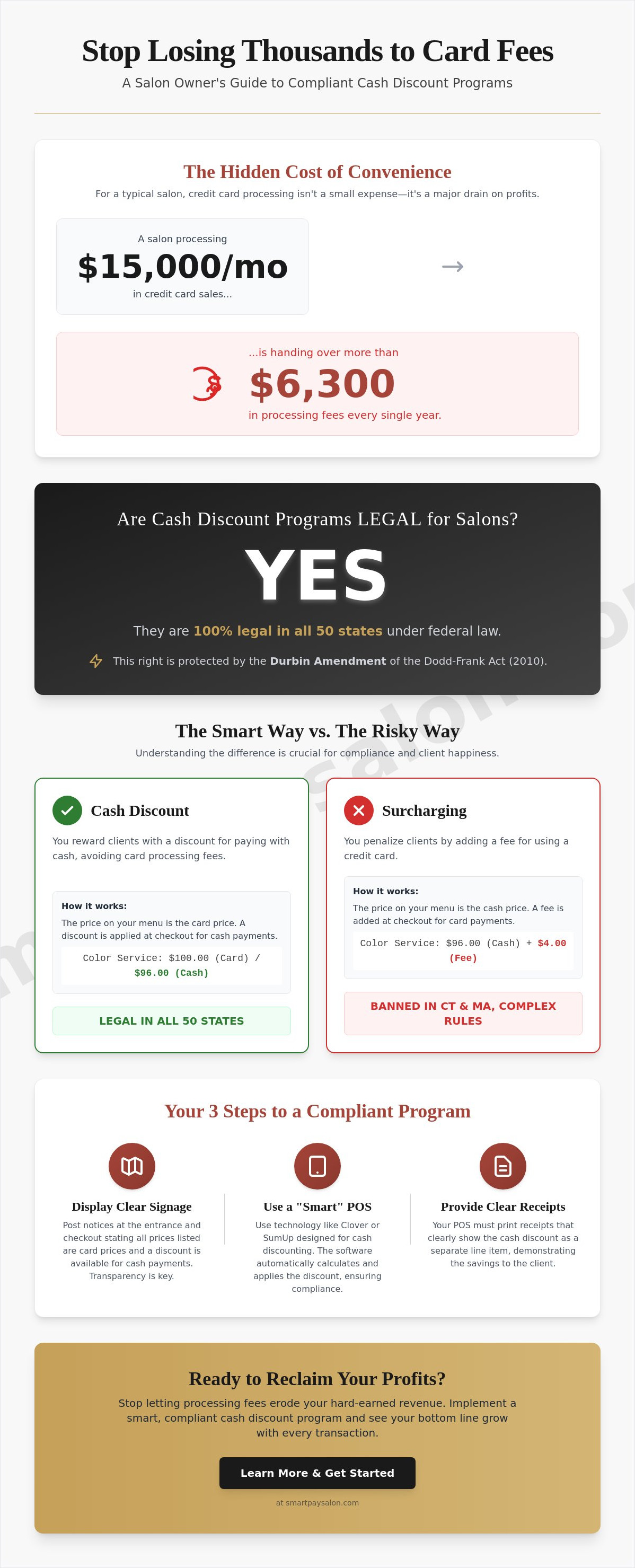
Did you know that a typical salon processing $15,000 a month in credit card sales is essentially handing over $6,300 every year just to let clients swipe their cards? After 30 years in the beauty industry and 20 years behind the chair as an owner, I have seen those "invisible" fees eat away at margins that are already thin. You want to stop the bleeding, but you are worried about the rules. You have likely asked yourself: is a cash discount program legal for salons, or will it get my merchant account flagged? It is a valid concern when the difference between a fee and a discount feels like a legal tightrope.
I am here to give you a clear answer and some peace of mind. As of May 2026, cash discount programs are 100 percent legal in all 50 states, even in places like Connecticut and Massachusetts where surcharging is still prohibited. In this guide, I will share the exact roadmap for implementing a compliant program that protects your reputation and boosts your net profit on every color service. We will look at the latest Visa and Mastercard caps and the specific signage you need to stay in the clear. Let's turn those processing headaches into salon savings together.
Key Takeaways
- Learn why the answer to "is a cash discount program legal for salons" is a definitive yes, backed by federal law and industry standards for 2026.
- Discover how the Durbin Amendment protects your right to offer cash incentives without interference from big bank card networks.
- Master the "Neighborly Rule" to ensure you don't confuse a surcharge with a discount, keeping your salon compliant in all 50 states.
- Identify the smart hardware and POS setups that automate your pricing and eliminate the manual math that causes accounting headaches.
- Access a proven script for your stylists to handle client questions with confidence, ensuring your community feels valued rather than "fee'd."
Let’s Talk Shop: Is a Cash Discount Program Actually Legal for Your Salon?
Let's get the big question out of the way first because I know it is the one keeping you up at night while you look at your monthly statements. So, is a cash discount program legal for salons? The short answer is a resounding yes. It is 100 percent legal under federal law in all 50 states. I have spent 30 years in the beauty industry and 20 of those as a salon owner, so I have seen every "hidden fee" trick in the book. For decades, we were told by big banks that we just had to eat these costs as the price of doing business. That simply isn't true anymore.
A Cash Discount Program is a legal incentive for cash payments under the Durbin Amendment that allows business owners to offer a lower price to clients who choose not to pay with a credit card. It's really that simple. You are essentially rewarding your clients for helping you avoid those 2.5% to 3.5% processing bites. When I first started out, we didn't have these options. We just watched our margins get thinner every time a card brand decided to hike their rates. Today, the law is on your side, and it is time you used it to protect your take-home pay.
The Dodd-Frank Act and Your Right to Discount
The legal backbone of your right to save money comes from the 2010 Dodd-Frank Act. This federal law was a game changer for small business owners like us. Before this, card networks often tried to bully merchants into hiding the true cost of processing. By Understanding the Durbin Amendment, which is a specific part of that act, you can see how the government stepped in to ensure we have the right to offer incentives for different payment types. This shifted the responsibility. Instead of the salon owner bearing the entire burden of a client's choice to use a rewards card, the cost is shared or avoided entirely through a cash discount. It is the best friend your profit margin has ever had.
Why "Legal" Doesn’t Always Mean "Compliant"
Now, here is where it gets a little sticky, and why some owners get nervous. There is a difference between federal law and the specific rules set by Visa and Mastercard. The "processing police" aren't going to show up at your door, but if your program isn't set up correctly, your merchant processor could flag your account. This is usually where the headaches start. To stay safe, you need to follow specific signage and receipt requirements that the card brands updated as recently as 2024. This is why using "Smart" technology is so important. When you use a system like Clover or SumUp that is built for salons, the compliance is baked into the software. It handles the math and the disclosures automatically so you can focus on the hair and the hustle without worrying about a compliance letter in the mail.
Understanding the Durbin Amendment: The Law That Changed Salon Processing
I remember back in the early 2000s when we just ate the 3 percent processing fee because we thought we had to. It was just another expense, like buying backbar towels or cleaning hair out of the drains. We didn't know we had rights as merchants. Then the 2010 Durbin Amendment came along and completely flipped the script for small business owners. It basically told the big card networks they could no longer stop us from being smart with our money. If you have ever wondered is a cash discount program legal for salons, this federal amendment is the reason the answer is a firm yes. It prevents card companies from punishing you for rewarding your clients who pay with cash or debit.
There is a specific detail called the "Debit Card Loophole" that every owner needs to understand. Under federal law, banks with more than $10 billion in assets have their interchange fees capped at 21 cents plus 0.05 percent of the transaction. Because these fees are so low, it is actually illegal to apply a surcharge to a debit card in all 50 states, even if the client runs it as "credit" without a PIN. This is where many salons get into trouble with generic processors. A true cash discount program avoids this mess entirely because you aren't adding a fee to the card; you are offering a lower price for the cash payment. It is a subtle difference that keeps you 100 percent compliant.
Federal Protections for Small Business Owners
The Durbin Amendment did more than just cap fees; it gave us the freedom to steer our business. You have the protected right to set a $10 minimum for credit card transactions, which is a lifesaver for those small retail sales like a single bottle of hairspray. If you are Navigating State Laws, you will see that while some states have been grumpy about surcharges in the past, these federal protections ensure you can always offer a discount. In May 2026, these rights are vital as we look to recover every penny of our margins from rising overhead costs.
The Role of the Merchant Service Provider
You need a partner who understands our world. Generic processors often use a "one size fits all" approach that can leave you vulnerable to card brand audits. At SmartPay, we focus on making sure your Clover or SumUp system follows every Durbin rule automatically. We help you unlock salon savings by setting up your hardware to handle the math for you. You shouldn't have to be a legal expert to run a successful business. You just need the right tools that are built specifically for the beauty industry, ensuring your processing is as seamless as a perfect balayage blend.
Cash Discounting vs. Surcharging: Why the Distinction Matters for Your Brand
When you are standing at your front desk, the "vibe" of the checkout process matters just as much as the haircut itself. I call this the Neighborly Rule. If a client expects to pay $100 but sees $104 on their receipt because they used a card, they feel like they are being penalized for their payment choice. That is a surcharge. However, if your service price is $104 and you offer them a $4 discount for using cash, they leave feeling like they just got a little bonus. This distinction is the secret to why is a cash discount program legal for salons in places where surcharging might be restricted. A surcharge is a penalty for card use, while a cash discount is a reward for cash use.
Many owners run into what I call the Stripe Headache. Generic platforms are great for selling products online, but they often struggle with the nuanced legal requirements of the beauty industry. They might simply add a flat fee to every transaction. This technically turns your program into a surcharge, which can lead to compliance issues in certain states. By contrast, a true cash discount program is protected by the Durbin Amendment, which ensures merchants have the right to offer incentives for cash payments. This federal protection is what allows you to eliminate those processing fees without looking like the "bad guy" to your clients or the bank.
The Psychology of the Discount
We work hard to build a luxury brand. You don't want your front desk to feel like a discount warehouse, but you also don't want to lose thousands of dollars a year to processing fees. The trick is in the framing. When my stylists talk to clients, they don't talk about "fees." They talk about "sharing the savings." Clients react much better to the idea of saving money than they do to an unexpected charge. It keeps the relationship positive while protecting your bottom line. You are simply passing the savings of a cheaper payment method back to the person sitting in your chair.
Technical Compliance: Signage and Receipts
To keep things 100 percent compliant, you need to be transparent. This means having visible signage at your entrance and your register. Your receipts should also show a clear line-item for the cash discount or the non-cash adjustment. Many modern salons are moving toward Dual Pricing, where both the cash and card prices are shown right on the menu. It is the gold standard for transparency in 2026. This approach removes any "gotcha" moments at checkout and ensures your merchant account stays in good standing with the card brands.
Navigating State Laws and Card Brand Rules Without the Headache
By now, you probably feel a lot better knowing that the answer to is a cash discount program legal for salons is a clear yes. However, I have learned over 20 years of ownership that the "how" matters just as much as the "can I." As we move through 2026, the legal landscape has shifted. Most state-level bans on surcharging have been struck down by courts, but a few holdouts like Connecticut and Massachusetts still have strict rules against adding fees. This is why a cash discount program is so brilliant. It bypasses those state specific headaches because you are offering a lower price, not adding a penalty. It keeps you safe while keeping your profit margins healthy.
You also need to keep an eye on the card brands. Visa and Mastercard updated their core rules significantly between 2023 and 2024. For instance, Visa now caps surcharges at 3 percent. If your "generic" processor is still charging 4 percent, you are technically out of compliance and risking your merchant account. Then there is the "Third Rail" of processing: debit cards. You must never, under any circumstances, apply a surcharge to a debit card. It does not matter if the client chooses "credit" at the terminal. If that plastic is linked to a bank account, it is a debit transaction. A smart system recognizes this instantly and ensures you stay on the right side of federal law.
The 2026 Compliance Checklist
Staying compliant shouldn't feel like a part time job. My "Veteran Hack" is to always work with a provider who handles the legal heavy lifting for you. Here is what you need to check today:
- Merchant Category Code (MCC): Ensure your business is correctly coded as a salon (usually 7230 or 7298). Incorrect coding can lead to higher rates or audit red flags.
- POS Configuration: Verify that your Clover Station or Square setup is configured for a "True Cash Discount" where the discount is clearly itemized.
- Avoid "Service Fees": Some processors try to hide fees under this label. It is a legal gray area that often triggers client complaints and bank audits. Stick to the proven discount model instead.
Protecting Your Stylist Commissions
This is the part most general business guides miss. In our world, we have to think about how this affects our team. If you are running a commission salon, you need to decide if your stylists are paid on the "cash" price or the "card" price. I always recommend calculating commissions on the gross service price before any discounts are applied. This ensures the savings you are gaining on processing don't accidentally come out of your stylists' pockets. When your team sees that their take home pay is protected, they become your biggest allies in explaining the program to clients. You can see how SmartPay integrates with your existing salon software to make these calculations automatic and error free. It is all about creating a win-win for the owner, the stylist, and the client.
Stop guessing about your compliance and start growing your bottom line. If you are ready to stop losing money to big banks, you should unlock your salon savings today with a system built specifically for the beauty industry.
How to Implement a Compliant Program That Your Clients Will Love
Now that we have settled the big question of whether is a cash discount program legal for salons, let's talk about the practical side. I have helped dozens of owners make this transition. The secret is not in the legal fine print; it is in the way you present it to the person sitting in your chair. After 20 years of running my own shop, I can tell you that your clients care more about the quality of their highlight than they do about how you process their payment. If you follow a simple, transparent roadmap, you can eliminate those fees and keep your community happy at the same time.
The first step is choosing the right hardware. I am a big fan of the Clover Station Duo or the Clover Station Solo. These systems look beautiful on a high end front desk and, more importantly, they handle all the compliance math automatically. Once your hardware is set, you need to train your team. I use an "Over the Fence" script that keeps things friendly and casual. Then, we look at your digital footprint. Whether you use Square or Zenoti, we use SmartPay Salon Solutions integrations to ensure your online booking and in person checkout stay perfectly synced. Finally, I always recommend a 30 day "Soft Launch." This gives you time to put up your signage and answer questions before the program becomes your new standard.
The "No-Pressure" Conversation
The way your front desk handles the checkout is everything. When a client asks about the new pricing, your team should have a relaxed, neighborly response ready. We use wording like: "We have implemented a program to keep our service prices stable instead of raising them for everyone." It is honest and relatable. You might encounter one grumpy client out of a hundred, but the key is to stay calm and informative. Most people understand that small businesses are feeling the pinch of rising costs. In my experience, 95 percent of clients don't actually care as much as you think they will, especially when they see you are just trying to keep your doors open and your stylists paid fairly.
Boosting Your Salon Profitability
Think about what that extra 3 to 4 percent back in your pocket could actually do for your business. For a salon doing $500,000 a year, that is an extra $15,000 to $20,000 annually. You could finally upgrade your backbar with that luxury line you have been eyeing, or you could dump that money into a "Client Retention Engine" like branded SMS marketing. This is where SmartPay Salon Solutions’ consulting really shines. We don't just set up your merchant account; we help you turn those savings into actual growth. Looking back at my own career, my only regret is that I didn't do this 10 years ago. It is the simplest way to give yourself a raise without working extra hours behind the chair. Start your cash discount journey today and see how much faster your business can grow when you stop paying the bank's bills.
Take Control of Your Salon's Financial Future
You have spent years perfecting every foil and fade. You deserve to keep the full value of that hard work. We have finally cleared the air on the big question: is a cash discount program legal for salons? With a 100 percent legal "yes" backed by federal law, you can stop losing that 2.35 percent average fee that Visa and Mastercard transactions cost most owners. By shifting to a reward-based model, you protect your luxury brand and your stylists' hard-earned commissions without the complexities and frustrations often associated with generic payment processors.
At SmartPay, we pair 30 years of beauty industry expertise with modern technology. We offer seamless implementation and a system that handles all the compliance math for you automatically. Our next-day funding keeps your cash flow strong so you can reinvest in your team or your backbar immediately. It is time to replace those processing headaches with smart simplicity and keep your profits where they belong.
Unlock Salon Savings with SmartPay’s Fully Compliant Cash Discount Program
You have built something beautiful. Now, let's make sure it is as profitable as it is professional. I am rooting for your success in 2026 and beyond.
Frequently Asked Questions
Is a cash discount program legal in all 50 states for salons?
Yes, is a cash discount program legal for salons in every state across the country as of May 2026. While states like Connecticut and Massachusetts still have bans on credit card surcharges, those restrictions don't apply to cash discounts. This is because you are rewarding cash use rather than penalizing card use, which is a protected right under federal law.
Can I apply a cash discount to debit card transactions?
No, you should never apply a non-cash adjustment to debit cards. Federal law under the Durbin Amendment treats debit cards differently because their interchange fees are capped at 21 cents plus 0.05 percent for large banks. Card brands consider debit cards to be the same as cash, so trying to "discount" them can lead to compliance flags on your merchant account.
Do I have to display a sign if I use a cash discount program?
Yes, transparency is a requirement for staying compliant. According to the 2024 card brand rule updates, you must display "clear and conspicuous" signage at both your salon entrance and your point of sale. This ensures your clients are fully informed about the dual pricing structure before they ever receive a service, which helps maintain trust and avoids checkout surprises.
What is the difference between a cash discount and a credit card surcharge?
It all comes down to your posted price. A surcharge adds an extra fee on top of your listed price when a client swipes a credit card. A cash discount program means your listed prices are the "card prices," and you offer a lower amount to anyone paying with cash. One feels like a penalty, while the other feels like a neighborly reward.
Will a cash discount program affect my salon’s tips?
In my 20 years of ownership, I have found that it actually doesn't hurt tips at all. Smart POS systems like Clover calculate the suggested tip percentages based on the original service price before any processing adjustments. Often, when a client feels they have saved a few dollars through a cash discount, they are more likely to pass that savings along to their stylist.
Is it legal to have a minimum purchase amount for credit cards in my salon?
Yes, you have a federally protected right to set a $10 minimum for credit card transactions. This was a key part of the 2010 Dodd-Frank Act. It is a lifesaver for those small retail sales, like a single bottle of travel-size hairspray, where the processing fee could easily wipe out your entire profit margin on the item.
What happens if I don’t follow the card brand rules for discounting?
You won't go to jail, but you could lose your merchant account. If Visa or Mastercard finds your program is non-compliant, they can issue heavy fines or even terminate your ability to accept their cards. This is why I always recommend using a "Smart" system that automates the math and signage requirements so you stay on the right side of the rules.
How do I explain the new program to my long-term salon clients?
Just be honest and keep it casual. Tell them that instead of doing a general price increase for every client to cover rising bank fees, you've found a way to keep your service prices stable by sharing the savings of cash payments. Most of my regulars were happy to help me keep more money in the business rather than handing it to the banks.