

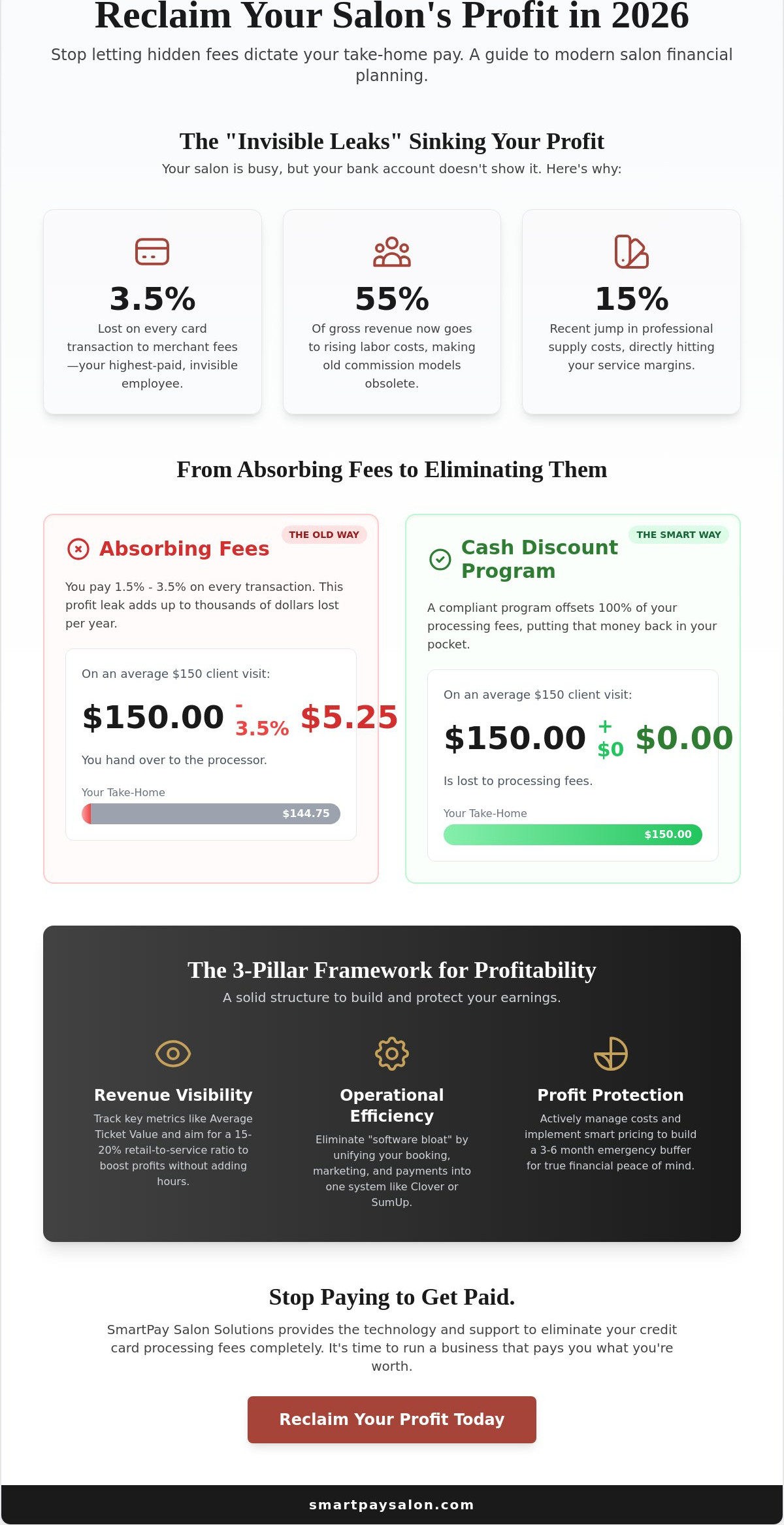
Your credit card processor shouldn't be your highest-paid employee, yet they often take a bigger cut than your top stylist. With the average consumer spending $150 per visit in 2026, losing 3.5% of every swipe to merchant fees isn't just a nuisance; it's a direct hit to your personal take-home pay. I've spent 30 years in the beauty world and 20 years as a salon owner, so I know that feeling of looking at a packed Saturday book and wondering why the bank balance doesn't reflect the hustle. Mastering salon financial planning 2026 isn't about adding more hours to your day. It's about plugging the "invisible leaks" in your processing and inventory that keep your margins stuck at the lower end of the industry's 10% to 25% average.
You worked too hard to let fragmented software and rising labor costs, which now hit 55% of gross revenue, eat your dream alive. I'm going to show you a simple roadmap to reclaim your profit and simplify your life. We'll discuss how to eliminate processing fees entirely through a cash discount program and build a predictable budget that works. It's time to stop the software headaches and start running a business that actually pays you what you're worth.
Key Takeaways
- Stop letting merchant fees act as "invisible rent" and learn why traditional budgeting is failing in the current economy.
- Discover the 3-Pillar Framework to separate your service, retail, and membership income for total revenue visibility.
- Master a professional 5-step reset for salon financial planning 2026 to identify "ghost" subscriptions and audit your true service margins.
- Compare the "Traditional" way of absorbing credit card fees against the "Smart" way of implementing a compliant Cash Discount Program.
- Learn how to simplify your tech stack and hardware to turn fragmented software into a unified profit engine.
Why Traditional Salon Budgeting is Failing in 2026
I've spent 30 years behind the chair and 20 of those years running my own shop. I've seen every trend from the perm craze to the modern balayage. One thing I've learned is that the old ways of balancing the books don't work anymore. In 2026, the economy is moving faster than a stylist on a Saturday morning. You can't just look at your bank balance once a month and hope for the best. Developing a comprehensive financial plan is about more than just tracking what comes in; it's about understanding the core components like cash flow and income statements that keep your doors open. Right now, salon financial planning 2026 requires a shift from passive tracking to active protection of your hard earned equity.
Many owners fall into the "Busy Salon" trap. Your chairs are full, your social media is buzzing, and your revenue is higher than ever. Yet, at the end of the month, there's nothing left for you. This happens because of the "Invisible Leak." For most salons, merchant processing fees have become a second rent. When you're paying between 1.5% and 3.5% on every transaction, you're essentially handing over a massive chunk of your profit to a bank that doesn't help you sweep the floors. Salon Financial Planning is a living strategy to protect owner equity.
The 2026 Inflation Impact on Backbar and Rent
We've seen professional supply costs jump by 15% recently. That's a direct hit to your service margins that most owners haven't adjusted for. The old "15.24 rent rule" is also outdated because utility costs and property taxes have climbed so high. I see too many talented owners get caught in the "House Poor" trap. They build a gorgeous, high-end space but don't account for the increased overhead, leaving them with a beautiful salon and a zero dollar paycheck.
Labor vs. Profit: The New Commission Reality
Labor is your biggest expense, typically eating up 45% to 55% of your gross revenue. The traditional 50/50 commission model is breaking because it doesn't leave room for the rising costs of doing business in 2026. With salon suites offering stylists a way to keep more of their "behind the chair" money, you have to find a way to stay competitive without going bankrupt. Balancing stylist loyalty with business survival means looking at service fees or price adjustments that reflect the true cost of your talent and your time. It's about being fair to them while being honest with yourself about the numbers.
The 3-Pillar Framework for Salon Profitability
I always tell my neighbors in the industry that you can't fix what you can't see. After we identify those "invisible leaks" we discussed earlier, we need a solid structure to hold the profit in. I like to call this the 3-Pillar Framework. It's the backbone of salon financial planning 2026, and it's what allowed me to finally stop worrying about my bank balance every Tuesday morning. These pillars aren't just about spreadsheets; they're about creating a business that serves you as much as you serve your clients. When you master these, you're not just surviving; you're building a 3 to 6 month emergency buffer that lets you breathe easier.
Revenue Visibility: Knowing Your Numbers
Most owners focus on the total daily intake. That's a mistake. You need to look at your "Average Ticket Value" per stylist. With the average U.S. consumer spending $150 per visit in 2026, knowing exactly who is hitting that mark helps you coach your team more effectively. You also want to keep a close eye on your retail-to-service ratio. Top-performing salons aim for retail to account for 15% to 20% of total revenue. This retail income is vital because it helps offset your fixed overhead without adding extra labor hours. Following some essential financial tips like monitoring cash flow weekly rather than monthly can make the difference between a slim margin and a healthy 25% profit.
Operational Efficiency: The Tech Stack Audit
Stop and think about how many apps you're paying for right now. "Software Bloat" is a silent profit killer. If you're using one app for booking, another for marketing, and a third for payments, you're likely overpaying and wasting hours on administration. A centralized dashboard, like what you get with a Clover or SumUp system, unifies your entire business. It's much easier to spot trends when your data lives in one place. If you're feeling overwhelmed by the tech, a bit of salon profitability consulting can help you trim the fat and get back to what you love doing.
The final pillar is Margin Protection. This is the strategy of keeping what you actually earn. By cutting out those fragmented software costs and managing your processing fees, you protect the equity you've built. This isn't about working more hours; it's about ensuring the hours you already work are as profitable as possible. Protecting your margin is the only way to ensure your salon remains a stable asset for years to come.
Comparing the 'Absorb' vs. 'Cash Discount' Processing Models
I remember back in the 90s, we just accepted credit card fees as a "necessary evil." We'd see that 3% or 4% disappear from every swipe and just shrug it off. But let's be real; it's 2026, and those "small" percentages are now huge numbers. If you're serious about salon financial planning 2026, you have to look at the "Smart" way of doing things. A Cash Discount Program is simply a way to reward cash-paying clients while protecting your margin. It's about being transparent with your guests and keeping more of what you actually earn at the chair.
The biggest hurdle for most of my friends in the industry is the fear of client pushback. They worry people will leave if they don't get their credit card points. But here's the thing: most clients would rather have you stay in business and keep your service prices fair than get a few pennies back in rewards. When you explain it like a neighbor, telling them you're doing this to avoid a general price increase for everyone, they almost always understand. When you're looking at the SBA guide to financial projections, it becomes very clear that managing these variable costs is what separates a struggling shop from a thriving one.
The Math of the Switch: A Real-World Example
Let's look at the numbers for a salon doing $50,000 a month in revenue. If you're "absorbing" those fees at a 3.5% rate, you're losing $1,750 every single month. That's $21,000 a year. Imagine what you could do with an extra $21,000 in your pocket. That covers your rent for a few months or buys that new equipment you've been eyeing. When you switch to a cash discount model, that $1,750 stays with you. It's like giving yourself a massive raise without adding a single new client to the book.
Hardware and Integration: Clover vs. Square
You don't have to throw out everything you're using to make this work. If you're attached to your current booking software, a Square Integration can help you bridge the gap and save on fees. However, for a truly seamless front desk, I'm a huge fan of the Clover Station Duo or the portable Clover Flex. These systems are "Built for Salons" and handle the math for you automatically. Plus, with Next-Day Funding, you aren't waiting around for the bank to release your money. It's your cash; you should have it when you need it.
How to Perform a 5-Step Salon Financial Reset
If you're feeling like the bank is your silent partner, it's time for a reset. I've found that a tactical, step by step approach is the only way to get clear on your salon financial planning 2026. Let's walk through this like we're sitting at the breakroom table sharing a coffee. This isn't about complicated accounting; it's about taking control of your shop's future so you can finally start paying yourself what you're actually worth.
The 7-Day Audit: Where is the Money Going?
Step one is a 7-day expense audit. Grab your most recent merchant statement and look for those sneaky "PCI Compliance" fees or "Statement Fees." If you're seeing these charged monthly, you're likely overpaying for a service that should be simple and transparent. I also recommend the "Clear Bucket" strategy for backbar waste. This veteran trick involves putting all your wasted color and product in a clear container for one week. Seeing that physical waste in plain sight usually reveals more about your eroded margins than any spreadsheet could. Finally, look at your "hairdressing app" costs. If you're paying for five different subscriptions but only using the booking feature, you've got a software leak that needs plugging.
Setting Your 2026 Pricing Strategy
Step two and three involve a deep dive into your service costs and pricing. With professional supply prices up 15% since the start of last year, your $100 color service might only be netting you $20 after labor and product. You have to know your true margin. When your stylists hit the "85% Capacity" rule, meaning their books are consistently full, that's your green light to adjust prices. You don't need to be "salesy" or aggressive about it. Just share with your loyal guests that you're adjusting rates to continue providing the high quality products and education they've come to expect.
Step four is the big move: eliminating those processing fees through a compliant Cash Discount Program. This protects your margin on every single transaction. Finally, step five is reinvestment. Take the $1,500 to $2,000 you save each month and put it into a "Client Retention Engine" like branded SMS marketing. Instead of just paying the bank, you're paying for your own business growth. If you're ready to stop the guesswork and start reclaiming your profit, our salon profitability consulting can help you map out these steps without the usual tech headaches.
Partnering for Growth: How SmartPay Salon Solutions Helps
I've spent two decades managing the beautiful chaos of a busy salon, so I know that a Saturday morning rush isn't the time to be fighting with a "generic" credit card terminal. That's exactly why we built SmartPay Salon Solutions. We combined 30 years of beauty industry experience with modern technology to create something that actually works for people like us. We aren't here to give you a high-pressure sales pitch. We take a neighborly approach because we've been in the trenches too. Our goal is to help you master salon financial planning 2026 by providing the tools and consulting you need to keep your profit where it belongs: in your pocket.
Beyond Processing: Profitability Consulting
We look at your whole business, not just your swipe fees. While most providers just want to sell you a merchant account, we act as a tech-savvy consultant for your entire operation. We understand how a professional client experience is directly tied to your hardware and software integration. Whether you're using a Clover Station Duo for a robust front desk or a SumUp POS for a more minimalist, mobile look, these tools create a seamless checkout that your clients will appreciate. If you're already in love with your current booking software, our Square Integration keeps your workflow smooth while saving you thousands in unnecessary processing fees. It's about unifying your tech stack so you can focus on your artistic craft, not your administrative headaches.
Ready to Stop Juggling and Start Growing?
Think of this as an "over the fence" chat between two salon owners. I'd love to sit down and look at your last merchant statement with you. We can spot those "invisible leaks" together and see exactly where you can reclaim your margin. There's no pressure and no aggressive tactics. In a quick 15-minute discovery call, we'll talk about your specific growth goals and how to simplify your daily operations. Stop wondering why the bank balance doesn't match your hustle. Start building a recession-proof business that supports your lifestyle and your team. Unlock Your Salon Savings with a Free Profitability Audit today and let's get your salon on the path to predictable, smart growth. Built for Salons. Powered by Smart Technology.
Take Control of Your Salon's Financial Future
You've spent years building your dream, one client at a time. Now it's time to make sure that dream actually supports your life. We've walked through the importance of revenue visibility and the simple math of the Cash Discount Program. The core of salon financial planning 2026 is realizing that you don't have to work more hours to see a bigger paycheck. By plugging the invisible leaks in your merchant processing and unifying your tech stack, you can reclaim the profit that is already yours.
I've been in this industry for 30 years and owned salons for 20, so I know that change can feel like just another task on a long list. That's why we offer specialized Square and Clover integrations to keep your front desk running smoothly while you eliminate 100% of your processing fees. Let's sit down and look at your numbers together to find those hidden savings. You have the talent and the hustle; now let's make sure your bank account reflects it.
Start Your 2026 Financial Reset with a Free Salon Profitability Audit
You've got this. I'm looking forward to helping you build a business that feels as good as it looks. Your future self will thank you for taking this step today.
Frequently Asked Questions
Is a Cash Discount Program legal for my salon?
Yes, a Cash Discount Program is legal in all 50 states as long as you follow clear signage and disclosure rules. It works by offering a lower price for cash payments while the regular price applies to card transactions. This approach is a cornerstone of salon financial planning 2026 because it protects your margins from the 3.5% hit most processors take on every swipe.
How much should I set aside for taxes in 2026?
You should set aside approximately 25% to 30% of your net income to cover federal, state, and self-employment taxes. For 2026, the self-employment tax rate is 15.3%, which covers Social Security and Medicare. Staying disciplined with these savings ensures you aren't scrambling when quarterly estimated tax payments are due on April 15, June 15, September 15, and January 15.
What is the ideal payroll percentage for a profitable hair salon?
The ideal payroll percentage for a profitable salon in 2026 is between 45% and 50% of gross revenue. While industry averages often climb to 55%, keeping labor costs at the lower end allows you to maintain a healthy 10% to 25% profit margin. If your labor costs are creeping higher, it's usually time to look at your service pricing or your retail-to-service ratio.
Can I keep my current booking software if I switch to SmartPay?
Yes, you can absolutely keep your current booking software while switching to a smarter processing model. We offer a specialized Square Integration that bridges the gap between the apps you love and the savings you deserve. This allows you to maintain your client visit history and online booking flow without being forced into a fragmented software trap that kills your efficiency.
How often should I review my salon's financial reports?
You should review your cash flow weekly and your full profit and loss statement once a month. Weekly check-ins help you spot immediate issues with backbar waste or low average ticket values. Monthly reviews are essential for salon financial planning 2026 because they allow you to compare your actual spending against your budget and adjust for rising utility or professional supply costs.
What happens if a client complains about the non-cash adjustment fee?
Most clients don't mind the adjustment when you explain that it helps you avoid a general price increase for every guest. Transparency is your best friend here. If a client asks, simply share that this program allows you to continue using premium products and offering top-tier education for your stylists without raising your service menu rates across the board.
How much emergency savings should a salon owner maintain in 2026?
A salon owner should maintain an emergency fund that covers 3 to 6 months of fixed overhead costs. This includes your rent, utilities, and base payroll. Having this buffer ensures that a slow month or an unexpected equipment repair doesn't derail your business. It's the best way to keep your stress levels low during the typical seasonal dips in the beauty industry.
Is it better to lease or buy my salon POS hardware like Clover?
It is generally better to buy your POS hardware like a Clover Station Duo or Clover Flex rather than leasing it. Leasing often leads to long-term contracts and higher total costs over time due to hidden interest. When you own your equipment, you have more control over your merchant account setup and can avoid the restrictive terms that often come with equipment leases.