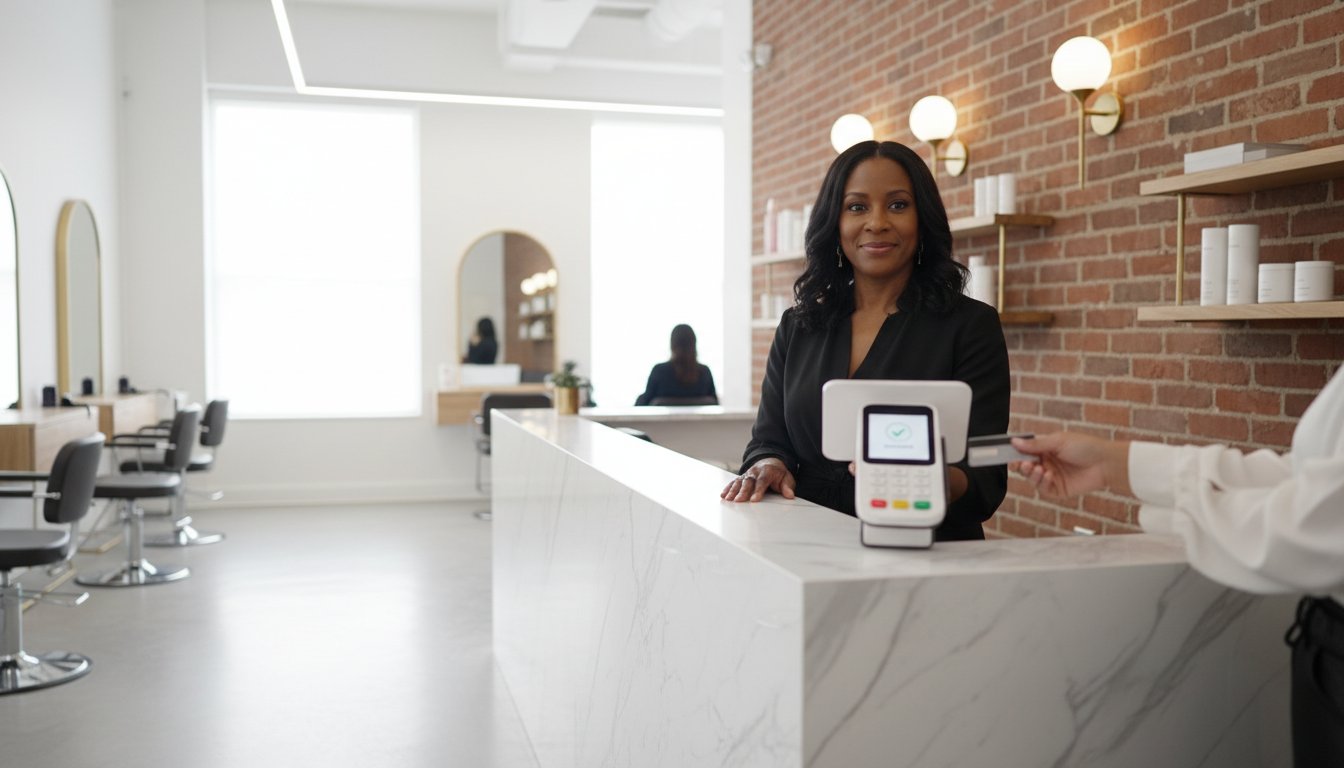
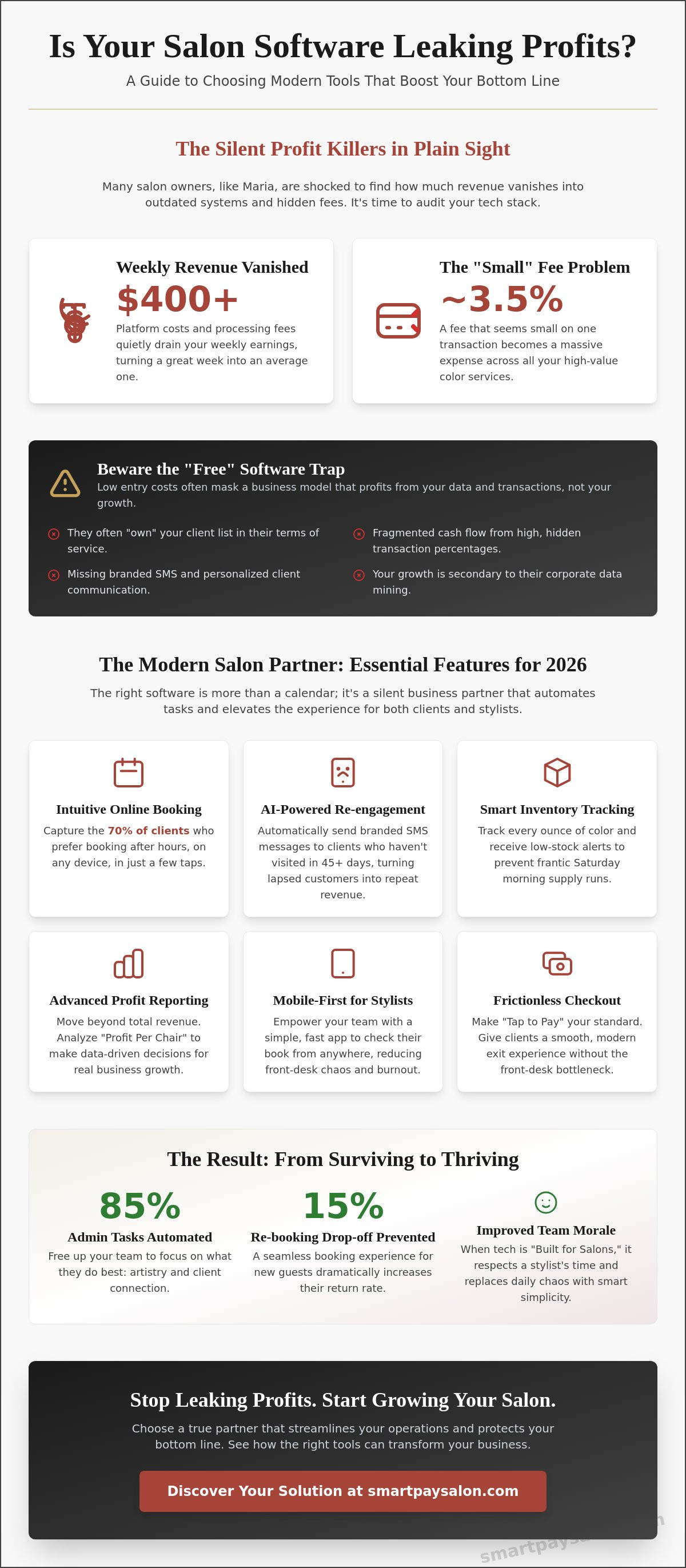
Last Saturday afternoon, a local owner named Maria showed me her end-of-day report; she was shocked to see that over $400 of her weekly revenue had vanished into processing fees and platform costs. After 30 years in the beauty industry and 20 years running my own shops, I've seen too many talented stylists lose their hard-earned margins to clunky, expensive systems. Choosing the right hair salon computer software shouldn't feel like a compromise between modern convenience and your take-home pay.
You probably agree that your booking system should work for you, not the other way around. It's frustrating to watch 3.5% of every expensive color service get eaten by a middleman while you're also paying a high monthly subscription fee. I'm going to help you navigate these tech choices so you can find a solution that streamlines your calendar without the hidden headaches or hardware crashes. We will explore how to audit your current fees and select reliable tools that keep your Saturday rush moving smoothly.
Key Takeaways
- Reflect on 30 years of industry evolution to understand why your software is now the "digital front door" of your business.
- Discover how the right hair salon computer software can automate client re-engagement and streamline online booking across every device.
- Learn to identify common payment processing pitfalls by calculating the true impact of hidden fees on your monthly bottom line.
- Compare various modern point-of-sale hardware options to find the perfect balance between front-desk aesthetics and technical reliability.
- Follow a practical 30-day roadmap to audit your current tech stack and stop profit leakage from fragmented systems.
The Evolution of Hair Salon Computer Software: A Veteran’s Perspective
I have spent 30 years in the beauty industry and 20 of those years as a salon owner. I remember the days when our entire business lived in a massive, coffee-stained paper appointment book. If we misplaced that book, the business stopped. By the early 2000s, we transitioned to basic desktop programs, but the real shift happened recently. Today, hair salon computer software has evolved from a simple digital calendar into a sophisticated business partner that handles everything from your inventory to your reputation.
Your software is now the digital front door of your business. A 2023 industry survey revealed that 70% of clients prefer booking their appointments online after traditional business hours. If your system is down or difficult to use at 10 PM on a Tuesday, those clients will find a stylist who is accessible. We have moved away from fragmented tools toward unified ecosystems. This shift allows you to manage your team, your merchant processing, and your client re-engagement from a single, centralized dashboard.
The history of Appointment scheduling software shows a clear path from basic grids to the AI-powered platforms we use today. Modern systems don't just "take appointments"; they predict client behavior and fill gaps in your schedule automatically. It is a transition from reactive management to proactive growth.
Why "Good Enough" Software is Costing You Clients
Settling for mediocre tech is a silent profit killer. A friction-heavy booking experience results in a 15% drop in re-booking rates for new guests who value their time above all else. When your system is clunky, your stylists face scheduling errors that lead to burnout and frustration. In the landscape of 2026 tech, salon management efficiency is defined as the seamless automation of 85% of administrative tasks so your team can focus entirely on artistry and client connection.
The Problem with "Free" or "Cheap" Software Versions
Stop falling for the "free" software trap. Many marketplace platforms offer low entry costs but "own" your client list in their terms of service. You might save a small monthly fee only to be hit with high transaction percentages that eat your margins. This is the "Stripe headache" many owners face; it creates a fragmented cash flow that is hard to track. A cheap subscription often masks the lack of branded SMS tools and personalized support that a true growth partner provides. Choose a system that prioritizes your local growth over their corporate data mining.
Essential Features for Modern Salon Management in 2026
I spent 20 years behind the chair and another decade managing teams, so I know that the right tools make or break your sanity. By 2026, your hair salon computer software needs to do more than just hold a date. It has to act like a silent partner. You need intuitive online booking that looks just as good on an iPhone as it does on a desktop. If a client can't book their balayage in three taps while sitting on their couch at midnight, you're losing revenue. Recent data in the Digital State of Small Business report shows that 93% of small business owners rely on digital tools to improve efficiency, and our industry is no exception.
Your software should also handle the heavy lifting of client retention. AI-powered re-engagement tools send branded SMS messages to clients who haven't visited in 45 days. This isn't just a "miss you" text; it's a strategic revenue engine. Pair this with inventory management that tracks every ounce of color. You'll get an alert when you're down to your last two tubes of 7G, preventing those frantic Saturday morning supply runs. Finally, look for reporting that breaks down "profit per chair." Knowing your total revenue is fine, but knowing which station earns $150 per hour versus $75 per hour helps you make real growth decisions.
The Stylist Experience: Adoption is Everything
If your team finds the software frustrating, they'll stop using it. It's that simple. Your hair salon computer software must be mobile-first so a stylist can check their book from their pocket between foils. Avoid systems with feature-bloat that require ten clicks just to add a deep conditioning treatment. High-velocity salons need speed. When the tech is "Built for Salons," it respects the stylist's time and keeps the floor moving smoothly. This creates a stabilizing force that replaces daily chaos with smart simplicity.
The Client Experience: Beyond the Appointment
In 2026, clients expect a frictionless exit. This means "Tap to Pay" is the standard, not an option. Nobody wants to stand at a crowded front desk while their hair is still damp. Self-service rescheduling is another must-have. It reduces the 30% of phone time your front desk usually spends on basic calendar changes. I always recommend a branded client app over a generic marketplace listing. You want your clients looking at your brand, not a list of your competitors. If you're tired of the "Stripe headaches" and want a system that actually fits your workflow, it might be time to explore a unified solution that prioritizes your local growth.
The Feature vs. Fee Trade-off: Protecting Your Bottom Line
Stop falling for the "all-in-one" shiny object. I've spent three decades in this industry, and I've seen too many owners get caught in what I call the "Square Trap." You get a beautiful interface for your hair salon computer software, but you're paying for it through the nose in processing fees. It's a classic bait-and-switch. These platforms look like tech companies, but they're actually payment companies in disguise. They lure you in with a low monthly subscription, maybe $50 or $100, while quietly skimming 3% or more off every single transaction you run.
Let's look at the math. A mid-sized salon doing $50,000 in monthly sales might pay $1,500 in processing fees at a flat 3% rate. Compare that to a $50 software fee. Which one is actually hurting your bottom line? A veteran's rule I've lived by for 20 years is simple: never let your booking software dictate your profit margins. Before you sign a contract, check out this guide on how to choose the right software from the U.S. Small Business Administration to ensure you're looking at the total cost of ownership. You need to know if you're buying a tool or a tax on your revenue.
Unbundling Software and Payments
You don't have to use the processor your software recommends. Unbundling means you "bring your own merchant account" to the platform. This move alone can save a mid-sized salon $6,000 to $12,000 annually by escaping high flat-rate fees. When you unbundle, you should demand Interchange Plus pricing. Interchange Plus is a transparent pricing model where the salon owner pays the actual wholesale cost from the card brands plus a small, fixed markup to the processor. It's the only way to see exactly where every cent of your hard-earned money is going.
The Cash Discount Program: A Game Changer for Salons
This is where the real "over the fence" talk happens. In 2026, 78% of consumers are accustomed to seeing small service fees or "non-cash adjustments" at local businesses. A Cash Discount Program allows you to pass processing fees to non-cash payments legally and professionally. It's not about being greedy; it's about survival in a high-cost environment.
If you're worried about your regulars, just have a heart-to-heart. When they're in the chair, you can say, "To keep our service prices stable despite rising costs, we've moved to a model that rewards cash payments." Most loyal clients would much rather pay a $3 service fee on a credit card than see their haircut price jump by $15 across the board. It's about protecting your business so you can keep serving your community for another 30 years. Using hair salon computer software that supports these programs isn't just smart; it's essential for your growth.
Choosing the Right Hardware for Your Software
I spent 20 years behind a salon chair, and I can tell you that the quickest way to ruin a client's experience is a computer that freezes at checkout. That old, clunky PC at your front desk isn't just an eyesore. It's a liability. Modern hair salon computer software requires hardware that can keep up with your pace. If your system takes three minutes to boot up while a client is waiting to pay, you're losing more than just time; you're losing professional credibility.
When you're looking at Clover versus SumUp, think about your salon's specific aesthetic and workflow. Clover offers a robust, "all-in-one" feel that acts as a central hub. SumUp provides a minimalist, sleek design that fits perfectly in boutique spaces where counter space is at a premium. Beyond looks, you must prioritize cash flow. A 2023 JP Morgan Chase study found that the median small business holds only 27 days of cash buffer. This makes "Next-Day Funding" a necessity. You need your money in your bank account the next morning to handle inventory orders or unexpected repairs. Your hardware should also feature a reliable "offline mode." If the internet goes down on a busy Saturday, your hardware should store encrypted transactions and process them automatically once you're back online.
The Clover Ecosystem: Station Solo vs. Station Duo
The Clover Station Duo is a favorite for a reason. It features a customer-facing display, which allows clients to review their service total, select a tip, and sign for the transaction privately. It makes the checkout feel transparent and professional. If you prefer to keep the transaction at the stylist's station, the Clover Flex is the way to go. It empowers stylists to take payments and sell retail products right at the chair. This keeps the front desk from becoming a bottleneck during the afternoon rush.
Square Integration: The Best of Both Worlds
Many owners I talk to love their current Square software but feel the pinch of high processing rates. You don't have to throw the baby out with the bathwater. It's possible to keep the hair salon computer software interface your team already knows while lowering your overhead. By working with a specialist to integrate a new backend, the change remains invisible to your staff. This technical shift ensures your data stays secure and your history remains intact while you keep more of your hard-earned revenue.
Implementing Your New Strategy: A 30-Day Plan
After three decades in the beauty industry and twenty years running my own shops, I've learned that the best tools are useless if you don't have a clear plan to use them. You don't need a massive, stressful overhaul overnight. You need a steady, 30-day transition that protects your peace of mind while securing your profits. Start by auditing your current hair salon computer software and those confusing merchant processing statements from the last 90 days. Nearly 70% of salon owners I've consulted with find they're losing 3% or more of their total revenue to "junk fees" they never intentionally agreed to pay.
- Identify every hidden cost in your current processing setup by reviewing your effective rate.
- Consult with a profitability expert to find exactly where your revenue is leaking.
- Set up your new "Smart" technology dashboard to automate your client re-engagement and SMS marketing.
- Roll out a fully compliant Cash Discount Program to stop the drain on your margins immediately.
Transitioning Without the Trauma
Moving your client data and appointment history doesn't have to be a nightmare. Most modern systems allow you to export your database into a clean CSV file for a seamless import. I always recommend setting your "Go-Live" date for a Tuesday morning during the second week of the month. This avoids the weekend rush and the end-of-month accounting stress. When it comes to your stylists, talk to them like a friend over the backyard fence. Don't focus on the technical specs. Focus on how the new workflow handles the "Stripe headaches" and manual booking tasks that eat up their break time. If they see it saves them ten minutes between every client, they'll embrace the change without a second thought.
Maximizing Your New Profitability
Once you stop overpaying for processing, you'll see a sudden bump in your monthly bank balance. Don't just let that money sit there. Reinvest those savings into a high-impact marketing campaign or a new professional product line that carries a 50% margin. Your new hair salon computer software will provide the data you need to see which services are actually making money. You might discover that your "signature" service is actually a loss leader, while a simple 15-minute add-on is your biggest earner. It's easy to get lost in the creative side of the business. Remember, you're an artist at heart, but you're also the CEO of a local business. It's time to start acting like one.
Take Control of Your Salon's Financial Future
I've spent 30 years in the beauty world and 20 of those years running my own shops. I know exactly how it feels to balance a blow dryer in one hand and a messy spreadsheet in the other. Finding the right hair salon computer software isn't just about booking appointments; it's about reclaiming your time and protecting your hard-earned margins. We've covered the essential features for 2026 and how to implement a strategy that actually sticks. It's time to move past the technical hurdles that keep you stuck at the front desk until late every night.
My experience has shown me that the real profit killers are the hidden fees we often ignore. By using specialized Square and Clover integrations, you can eliminate up to 100% of your processing fees. This isn't a high-pressure pitch; it's just one veteran owner sharing a better way to work with another. You deserve a system that feels like a partner, not a burden. Unlock Your Salon’s True Profit Potential with SmartPay and see how simple your management can be. Keep pushing forward, because your best seasons are still ahead of you.
Frequently Asked Questions
Is it hard to switch my salon software if I have years of client data?
Switching is actually quite manageable since 90% of modern platforms now offer dedicated migration tools to pull your data. In my 20 years as an owner, I've seen transitions take less than 48 hours when you export your client lists into standard CSV files. Most providers even assign a specialist to handle the heavy lifting for you. You won't lose your history; you just move it to a better home.
How much does hair salon computer software typically cost in 2026?
You can expect to pay between $40 and $150 per month for a standard subscription in 2026. High-end systems with advanced marketing automation can reach $300 monthly. I always tell my fellow owners to look at the total cost of ownership. Some versions end up costing 3% more in hidden processing fees, so read those merchant agreements carefully before signing. It's about finding the balance between features and your bottom line.
Can I use a Cash Discount Program with my current booking software?
You can absolutely run a Cash Discount Program, provided your hair salon computer software supports dual pricing or surcharge logic. While legacy systems often struggle with this, about 75% of newer options include a toggle for these programs. It's a smart way to offset those 2.5% to 3.5% processing fees that eat into your margins. Just make sure your signage matches your software settings to stay fully compliant.
What is the difference between a POS system and salon management software?
A POS system is basically your digital cash register, while salon management software acts as the brain of your entire business. The POS handles the swipe and the receipt, but the management side tracks your 15% retail commission and sends out those branded SMS reminders. For a growing shop, you want a unified system. It prevents the headache of trying to make two different companies talk to each other every day.
Will my clients get upset if I start using a Cash Discount Program?
Most clients won't mind at all if you're transparent about the change. A 2023 industry survey showed that over 60% of consumers are now accustomed to seeing small service fees or cash discounts at local businesses. I've found that if you explain it's a way to keep your service prices stable, they're happy to support you. It's all about how you frame the conversation at the front desk during checkout.
Do I really need a dedicated salon software, or can I just use a digital calendar?
You definitely need dedicated hair salon computer software if you want to grow past a single chair. A digital calendar can't track your 35% re-booking rate or manage your color inventory. When I transitioned from a paper book to a smart system, my revenue increased by 20% in the first year just from automated appointment reminders. It's the difference between staying busy and running a professional business with real growth.
What hardware is best for a small booth-renter vs. a large commission salon?
Booth renters usually thrive with a simple tablet and a Bluetooth card reader for portability. For a large commission salon with 10 or more stylists, you'll want a stationary terminal and a dedicated front-desk computer. I recommend looking for hardware that uses 4G or 5G backup. Nothing stops a busy Saturday faster than the Wi-Fi going down when you have five clients waiting to check out and stylists ready for their next guest.
How does Square integration work with SmartPay Salon Solutions?
The integration works by linking your existing Square hardware to our specialized backend via a secure API. This means you keep the familiar Square interface while unlocking lower processing rates and salon-specific reporting. It's a seamless bridge that stops the Stripe headaches many owners face. You get the reliability of a global processor with the personalized touch of a team that actually knows what a balayage is and how your day flows.