
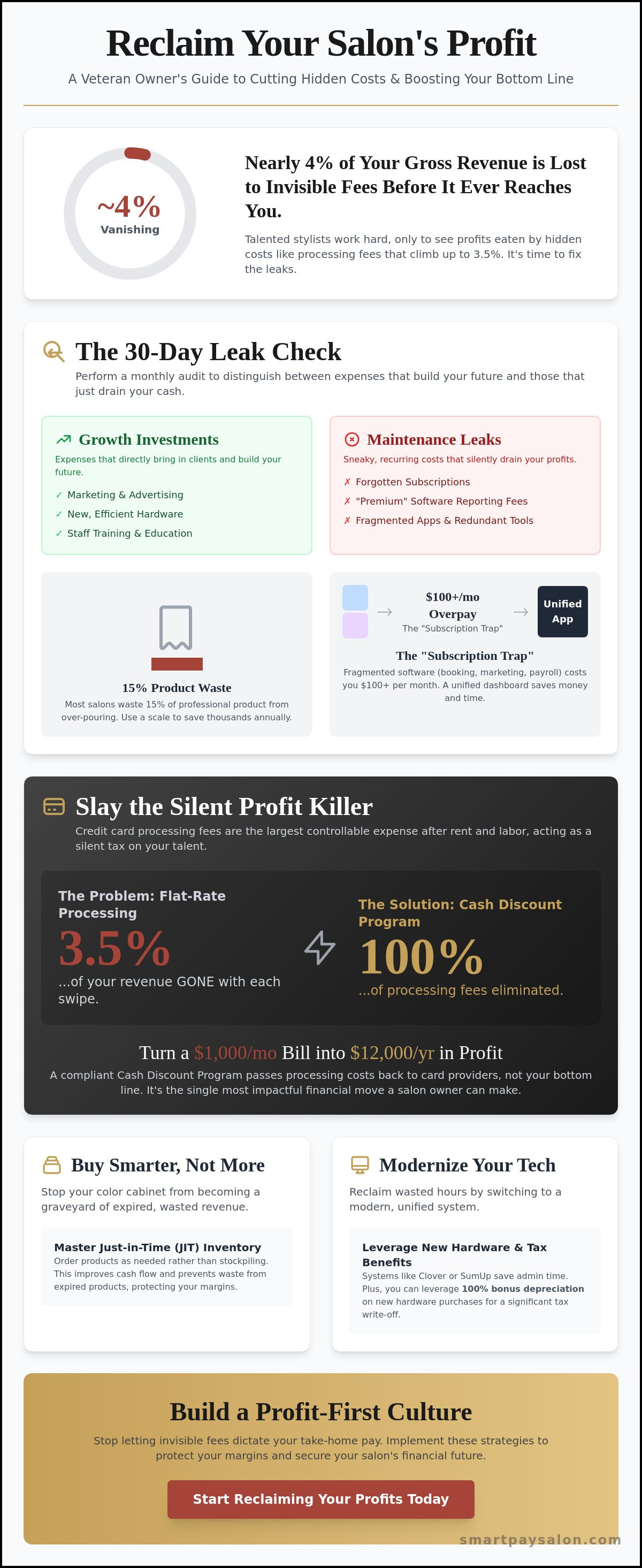
What if I told you that nearly 4% of your total gross revenue is vanishing before it even hits your bank account? After 30 years in the beauty industry and 20 years as a salon owner, I have seen too many talented stylists work themselves to the bone only to see their profit eaten away by invisible fees. You probably already feel the sting of credit card processing rates that climb as high as 3.5% for online bookings, making effective salon business expense reduction feel like an uphill battle. It's frustrating when you're doing the work, but the math just isn't adding up at the end of the month.
I understand that frustration because I've lived it, and I'm here to tell you that there's a better way to keep what you earn. This guide shares the exact strategies I use to identify hidden costs and reclaim your margins without sacrificing the quality of your services. We'll walk through everything from the 2026 IRS mileage rate of 72.5 cents to leveraging the 100% bonus depreciation on new hardware. You'll discover how to stop juggling fragmented software and start using a unified system that actually simplifies your life.
Key Takeaways
- Learn how to perform a 30-day leak check to spot forgotten recurring charges and separate your growth investments from maintenance drains.
- Discover the math behind a compliant Cash Discount Program that drives your salon business expense reduction by turning monthly processing bills into pure profit.
- Master the Just-in-Time inventory method to stop your color cabinet from becoming a graveyard of expired, wasted revenue.
- Identify which modernized hardware, from the Clover Station Duo to the SumUp POS, fits your specific business model to reclaim hours of admin time.
- Get a 90-day implementation roadmap to shift your team toward a profit-first culture that protects your take-home pay for the long haul.
The Veteran Owner’s Audit: Where Your Salon Money is Really Leaking
Every Sunday morning for twenty years, I sat at my kitchen table with a hot cup of coffee and my bank statements. It sounds like a chore, but that ritual kept my doors open when others were closing. I looked for the tiny holes in my bucket, what I call "maintenance leaks." These are the sneaky fees and forgotten subscriptions that don't help you grow. They just sit there, draining your hard-earned cash. This simple habit is the cornerstone of effective cost reduction strategies for any serious owner.
Start your own 30-day leak check today. Pull your last month of expenses and highlight anything that isn't directly bringing in a client. You'll likely find a "premium" reporting fee from a software company or a recurring charge for a magazine you haven't opened in years. This is the first step in a real salon business expense reduction plan. You need to distinguish between Growth Expenses, like your marketing budget, and Maintenance Leaks, like those hidden processing fees. One builds your future; the other just pays for someone else's.
Don't forget the backbar. In my three decades in the beauty world, I've seen that most salons waste about 15% of their professional product through simple over-pouring. If your team isn't using a scale or a strict measurement system, you're literally washing profit down the drain. It's a small change that can save you thousands by the end of the year.
Fixed vs. Variable Costs: A Salon Perspective
Understanding your numbers starts with a clear definition of your baseline. Salon overhead is the sum of every penny spent before a stylist touches a client.
Once you know that number, you can separate your non-negotiable rent from "luxury" overhead like expensive coffee pods or high-end bottled water. I always suggest talking to your vendors every six months. Ask them about loyalty bundles or if they have smaller shipping options that can help your cash flow. If looking at these numbers feels overwhelming, my Salon Profitability Consulting can help you spot the patterns you might be missing. It's about being proactive rather than reactive.
The "Subscription Trap" in Modern Salon Software
We live in an age of "app creep." You might have one app for your booking, another for your email marketing, and a third for your payroll. This fragmented approach is a silent profit killer. Most owners find they are overpaying by $100 or more every month just to keep these systems talking to each other. By moving to a unified, all-in-one dashboard, you don't just save money. You get a clear, real-time view of your financial health without the headache of managing multiple logins. Consolidating your tech stack is one of the fastest ways to see an immediate bump in your take-home pay.
Eliminating the Silent Profit Killer: Credit Card Processing Fees
Most accounting blogs tell you to focus on tax write-offs to save money. That is fine once a year. But if you want to see a real change in your bank account today, you have to look at the money leaving your salon every single day. Credit card processing fees are the largest controllable expense after your rent and labor. For a high-volume salon, these fees act like a silent tax on your talent. Many owners are stuck in flat-rate "Stripe-style" processing because it feels easy, but that convenience often costs 3% or more of your total gross revenue. Effective beauty industry financial management isn't just about cutting back on coffee. It is about fixing the "pipes" of your business.
Stop paying for your clients' airline miles. A Cash Discount Program allows you to reclaim your margin by passing the cost of processing back to the card providers. It is fully compliant and becoming the industry standard in 2026. Think about the math. If you are currently paying a $1,000 monthly processing bill, that is $12,000 a year. What would you do with an extra $12,000 in take-home pay? You could upgrade your stations, hire a new assistant, or finally take that vacation you have been putting off. This shift is the single most impactful move you can make for salon business expense reduction.
I know what you are thinking. You are worried that your regulars will be upset. In my experience, if you explain that this change allows you to keep your service prices stable while rewarding cash users, they understand. It is all about how you frame the conversation. You aren't penalizing card users; you are offering a reward for cash-paying clients.
How the Cash Discount Program Reclaims Your Margin
Let's look at a $100 haircut. In a traditional model, you might only see $97 after the processor takes their cut. With a Cash Discount Program, the client sees a service price of $100. If they pay with a card, a small service fee is added to cover the processing. If they pay cash, they get an immediate discount. You keep the full $100 every time. This model is a massive win for salon business expense reduction because it protects your profit on every single transaction.
Square Integration: Keeping the Software, Losing the Fees
You don't have to give up the booking software you love just to save money. Many owners stick with expensive processing because they like the Square interface. We offer a Square Integration that lets you keep your preferred front-end while switching the backend "pipes" to a more profitable merchant account. It is the best of both worlds for tech-savvy owners who want modern tools without the high-interest "Stripe headaches." Check out how our integration works to see if it's the right fit for your chair.
Inventory and Supply Chain: Buying Smarter, Not Just More
I remember walking into my stockroom early in my career and seeing rows of dusty color tubes that hadn't been touched in years. That is money just sitting there, gathering dust instead of interest. In my 20 years as an owner, I learned that your inventory is basically a pile of cash. If it's sitting on a shelf for six months, you've essentially given a zero-interest loan to a manufacturer. Real salon business expense reduction starts with changing how you look at those bottles.
For smaller suites or booth renters, I highly recommend the "Just-in-Time" inventory method. Instead of ordering a massive haul once a month, order exactly what you need for the next ten days based on your upcoming bookings. This keeps your cash flow fluid and prevents your cabinet from becoming a graveyard of expired products. I stopped buying from big-box retailers years ago because they thrive on bulk sales that don't fit the reality of a busy stylist. Now, I prefer the tailored approach of localized Salon Profitability Consulting to help me stay lean and focused on what actually sells.
Backbar Waste: The Invisible Expense
Backbar waste is the invisible leak that quietly eats your profit margins. If your team isn't using a scale for every bowl of lightener, you are likely over-pouring by at least 15% per service. I taught my staff to view every ounce of product as liquid gold. We implemented a simple measurement standard that reduced our backbar spend by nearly 20% in the first quarter. It isn't about being stingy; it's about being professional and precise with your resources. When you stop guessing, you start earning.
Maximizing Retail Margins to Offset Overhead
Think of retail as a self-funding engine for your business. A healthy 50% to 100% markup on a curated selection of products can easily cover your monthly utility bill or your software costs. The key is to keep your retail shelf "tight." Don't try to be a department store. Pick five products you truly love and recommend them like we do on QVC. It's a friendly, neighborly conversation about what works. When you share your knowledge instead of a sales pitch, your clients feel cared for, and your overhead starts to pay for itself. This shift in mindset is a powerful tool for salon business expense reduction that actually grows your bottom line.
Modernizing Your Tech Stack to Reclaim Wasted Hours
When I first opened my salon, my "tech stack" was a heavy paper appointment book and a corded phone. Things are different now, but many owners are drowning in what I call "tech debt." They use generic systems that don't talk to each other, which leads to wasted hours and manual entry errors. True salon business expense reduction happens when your hardware and software work in perfect harmony. It's like having a receptionist who never sleeps and never makes a mistake. When your systems are unified, you stop chasing paper and start focusing on the person in your chair.
For my friends running busy multi-chair shops, the Clover Station Duo is the gold standard. It handles the front desk rush with ease and keeps your merchant processing seamless. If you're a booth renter or a suite owner, you might prefer the SumUp POS. It is a low-profile, "smart" solution that stays out of your way while doing the heavy lifting of tracking your sales. Moving away from outdated, generic hardware reduces the cost of human error. Every time a stylist forgets to ring up a retail bottle or a deep conditioning treatment, your margin shrinks. An integrated system catches those leaks before they happen.
Choosing the Right Hardware: Clover vs. SumUp
There is a big difference between checking someone out at a counter and checking them out in the chair. The Clover Flex allows for that mobile, chair-side experience which often leads to higher retail sales and better tips for your team. It's a professional touch that clients notice. Whether you need the power of a Station Duo or the mobility of a Flex, using hardware that is "built for salons" ensures you aren't fighting with your tools during your busiest hours. You can explore our smart hardware options to see which setup fits your specific workflow.
Automation as an Expense Reducer
Automation is the ultimate labor-saving tool. Research shows that using an automated booking system can reduce no-shows by 15%, which saves you from the dreaded "no-show tax" on your time. I love using AI-powered re-engagement to reach out to "lost" clients who haven't visited in 90 days. It's a branded SMS strategy that acts as a client retention engine without you having to lift a finger. By automating these reminders and follow-ups, most owners find they reclaim 5 to 10 hours of administrative work every single week. That is time you can spend behind the chair or finally getting home in time for dinner.
Building a Profit-First Culture: Your Next Steps
After three decades in this industry, I've learned that the hardest part isn't the technical skill. It's the mental shift from being a stylist to becoming the CEO of your own space. You can have the best highlights in town, but if you don't manage your margins, you're just working for the landlord and the bank. Real salon business expense reduction is a marathon, not a sprint. It's about building a culture where profit isn't an accident. It's the goal. When you start thinking like an owner first, every decision becomes clearer.
I often tell my friends that we all get "salon blindness" eventually. You walk past that leaking backbar bottle or ignore that recurring $50 software charge because you're too busy making people beautiful. This is why having an outside perspective is so vital. A professional eye can often find $500 or more in monthly savings that you've simply stopped seeing because it's become part of the furniture.
The Value of Professional Financial Consulting
At SmartPay Salon Solutions, we act as a growth partner rather than just another vendor. We understand the specific headaches of merchant processing and how they differ from a standard retail shop. Our Salon Profitability Consulting is designed to help you peel back the layers of your overhead and find the hidden cash. Whether it's moving away from generic processors or unifying your tech stack, we help you make sense of the math. You can Learn how our consulting can help you grow faster by letting us help you identify those invisible leaks.
Your 2026 Action Plan
Don't let this information overwhelm you. I want you to follow a simple 90-day implementation plan to get your house in order. If you take it one step at a time, the progress will stick. Here is how I recommend you start your first three weeks:
- Week 1: The Audit. Pull every bank statement and highlight every non-essential recurring charge. If you haven't used it in 30 days, cancel it.
- Week 2: The Process. Switch your merchant account to a Cash Discount Program. This single move can eliminate your processing fees and put thousands back in your pocket.
- Week 3: Automate. Set up your branded SMS reminders and AI-powered re-engagement tools to stop client churn before it happens.
My goal for you is to reduce your total expenses by at least 10% before the next quarter begins. It's entirely possible if you stay disciplined. My final "over the fence" advice is simple: don't try to change every single thing in one day. Pick one leak, plug it, and then move to the next. I've been where you are, and I promise that once you see those profit margins start to climb, you'll never want to go back to the old way of doing things. I'm rooting for you.
Reclaim Your Profit and Grow Your Legacy
Taking control of your salon business expense reduction isn't just about saving pennies. It's about building a sustainable future where you aren't working just to pay fees. We've explored how a simple 30-day leak check and a "Just-in-Time" inventory approach can keep your cash flow fluid. More importantly, we've seen how modern hardware and the right merchant strategy can protect every dollar you earn behind the chair. You've worked hard for years to build your reputation. You deserve to keep the rewards of that labor.
I've spent 30 years in the beauty world and 20 years as an owner, and I know that small changes lead to massive relief. Our veteran-led consulting helps you find those invisible savings while providing seamless integration with your existing Square or Clover hardware. You can actually eliminate up to 100% of your processing fees starting this month. It's time to stop playing defense and start growing your legacy with confidence.
Stop paying for your clients’ credit card rewards. Switch to SmartPay Salon Solutions today!
You have the talent and the drive. Now, you have the plan. I'm excited to see you reclaim your margins and finally get the paycheck you've earned. You've got this.
Frequently Asked Questions
Is a Cash Discount Program legal for my salon business?
Yes, Cash Discount Programs are 100% legal and fully compliant across all 50 states as of 2026. These programs are designed to reward clients for paying with cash rather than penalizing those who use cards. It's a transparent way to manage your merchant processing while keeping your service prices stable for your loyal regulars. I've found that being upfront with clients about these options actually builds trust.
Will my clients leave if I start passing on credit card processing fees?
In my 20 years of ownership, I've found that clients value transparency and quality over a small service fee. Most regulars understand that small businesses face rising costs. If you explain that this move helps you avoid raising your service prices, they're usually happy to support you. In fact, many appreciate the option to save a few dollars by bringing cash to their next appointment.
How much can I realistically save by switching from Square to a Cash Discount model?
If you're currently using Square, you're likely paying 2.6% plus a $0.10 fee for every in-person transaction. By switching to a Cash Discount model, you can effectively eliminate your monthly processing bill entirely. For a salon doing $30,000 in monthly sales, that is a salon business expense reduction of nearly $800 every single month. That is extra cash you can put right back into your retirement or salon upgrades.
Do I need to buy all new hardware to reduce my salon expenses?
You don't necessarily need to start from scratch with brand new equipment. While modern tools like the Clover Station Duo or SumUp POS offer incredible efficiency, we can often integrate with your existing systems. Our Square Integration allows you to keep the interface you're comfortable with while switching the backend to a more profitable merchant account setup. It's about making your current tools work harder for you.
What is the most overlooked tax deduction for salon owners in 2026?
The Section 179 deduction is a massive opportunity that many owners miss. For the 2026 tax year, you can deduct up to $2,560,000 for qualifying equipment like new styling chairs or high-end POS systems. Additionally, the IRS standard mileage rate for business use of a vehicle is 72.5 cents per mile as of January 2026. Keeping track of these numbers is a vital part of salon business expense reduction.
Can I still use my current booking software if I switch merchant providers?
Yes, you can usually keep your preferred booking software while upgrading your payment processing. We specialize in making these transitions seamless so you don't lose your client visit history or online booking flow. It's about finding the "best of both worlds" where you keep the software you love but stop paying the high flat-rate fees that eat your margins.
What happens if a client insists on paying with a credit card under a cash discount program?
If a client chooses to pay with a card, the system simply adds a small service fee to the transaction to cover the cost of processing. You still receive the full amount for your service, and the processor handles the fee directly. It ensures your profit remains consistent regardless of how the client chooses to pay at the end of their visit. It's a fair way to handle the rising costs of card rewards.
How do I know if my salon is big enough to benefit from professional consulting?
If you feel like you're working harder but seeing less profit at the end of the month, you're big enough for a consultation. Whether you're a single-chair suite owner or managing a team of ten, an outside eye can often spot "maintenance leaks" you've grown blind to. Professional consulting is a growth partnership that helps you finally shift from a stylist mindset to a CEO mindset.