

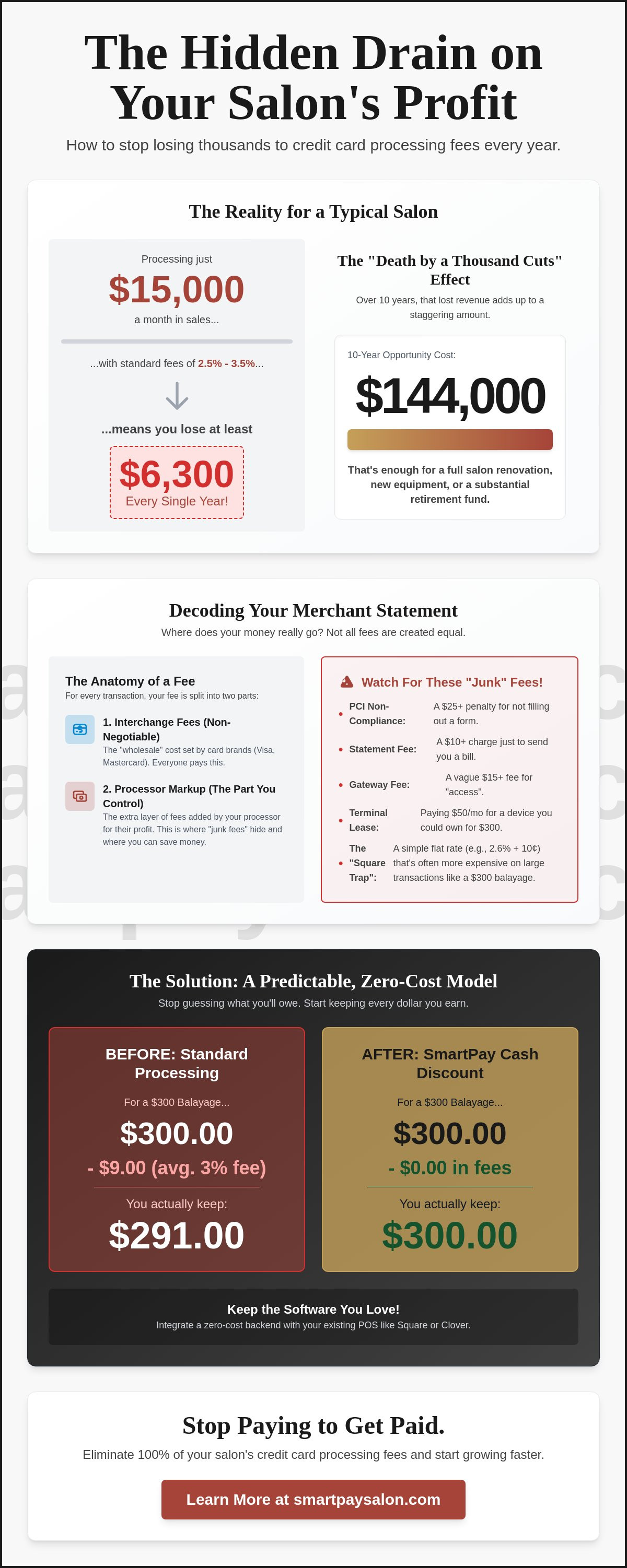
What if those monthly merchant statements that look like a foreign language were actually a choice rather than a mandatory tax on your talent? After 30 years in the beauty industry and 20 years as an owner, I know the frustration of watching $6,300 a year disappear into thin air. That is the reality for a typical salon processing $15,000 a month. You likely feel nickeled and dimed by salon credit card processing fees that currently range from 2.5% to 3.5% per swipe. It’s exhausting to see your hard work benefit a bank more than your own business.
I’ve learned that you don't have to choose between your profit and your peace of mind. Stop guessing what you’ll owe each month. Start keeping every dollar of your hard-earned revenue. I’ll show you how to decode those confusing statements and eliminate fees without losing the clients you love. We will explore the April 2026 rate updates and how you can keep using tools like Square or Clover while shifting to a predictable, zero-cost model. It's time to stop the "Stripe headaches" and start growing faster with a system built for our world.
Key Takeaways
- Learn why your salon margins are uniquely vulnerable to the standard 2.5% to 3.5% "tax" and how you can stop the hidden drain on your profits.
- Stop the confusion by learning how to decode your merchant statements to identify unnecessary junk fees and PCI non-compliance charges.
- Discover how to eliminate salon credit card processing fees entirely using a cash discount program that keeps your clients happy and your revenue whole.
- Master the "over the fence" communication style to explain fee changes to your clients as a way to avoid raising your service prices.
- Find out how to keep using the software you love, like Square or Clover, while swapping out the expensive back-end processing for a smarter solution.
The Hidden Drain: How Processing Fees Quietly Eat Your Salon’s Margins
I’ve spent 30 years behind the chair and 20 of those years paying rent on a building. In the early days, a client paying with a card was a rare treat. It was a convenience we were happy to pay a small fee for. Fast forward to 2026, and that convenience has morphed into a major liability. Today, roughly 95% of our transactions are digital. When you look at salon credit card processing fees that eat up 2.5% to 3.5% of every haircut and color, you realize you're not just paying for a service. You're paying a mandatory tax on your talent. It’s perfectly okay to feel annoyed that you are essentially funding your clients' tropical vacations with their travel points while your own margins shrink.
The Evolution of Salon Payments
The way we get paid has changed faster than hair trends. In the past, merchant accounts were simple and predictable. Now, processors have become experts at "bundling" costs to hide the true price of high-reward cards. Most of what you pay is driven by Interchange fees, which are the non-negotiable rates set by card brands like Visa and Mastercard. If you're still using a merchant account set up years ago, it likely isn't built for the high-volume, digital-first economy we live in now. It’s like trying to do a modern balayage with 20-year-old tools. It just doesn't work anymore.
Calculating the Real Opportunity Cost
Think about your monthly processing bill not as a "fee," but as a tangible salon expense. If you are paying $1,200 every month in salon credit card processing fees, that is $14,400 a year. Over a 10-year career, that total reaches $144,000. That is a new styling station, a complete lobby renovation, or a very comfortable retirement fund. This is "Death by a Thousand Cuts" in its purest form. Processing overhead is the silent partner who takes 3% of your gross without doing any work. When you see it that way, it’s easier to realize why we need to change the conversation.
We work in an industry where margins are already tight. We balance product costs, rising rent, and payroll. Adding a 3% drain on the top line can be the difference between a profitable month and just breaking even. You deserve to keep the money you earn from every snip and every foil. Let's look at how to take that power back without making things complicated for your staff or your favorite clients.
Decoding the Statement: A Plain-English Guide to Your Merchant Fees
Ever feel like your monthly merchant statement is written in a code designed to keep you in the dark? You aren't alone. After two decades of running my own shop, I still remember the headache of trying to figure out why my bill was hundreds of dollars higher than I expected. To understand salon credit card processing fees, you first have to know the three people sitting at the table. There is the Bank (who gave your client the card), the Card Brand like Visa or Mastercard, and the Processor. The first two are fixed costs. The third one, the processor, is where the "junk" usually starts to pile up.
Interchange vs. Markup
Think of Interchange as the "wholesale" cost of a transaction. It's the non-negotiable price set by the card brands that every business in the country has to pay. The Markup is what the processor adds on top to cover their own overhead and profit. This is the only part of the bill you can actually change. To find your "true" cost, take your total fees and divide them by your total sales for the month. That is your effective rate. If that number is north of 3%, you're likely paying for someone else's fancy office. Reviewing Modern payment solutions can help you see how your current markup stacks up against the 2026 industry standards.
Common 'Hidden' Fees in the Beauty Industry
I've seen some pretty creative ways to pull money out of a salon's pocket. Some companies charge a $25 PCI non-compliance fee just because a digital form wasn't updated. Others hide a $10 statement fee or a $15 "gateway" fee that adds zero value to your day. And please, whatever you do, don't ever lease a terminal. Paying $50 a month for a piece of plastic you could buy outright for a few hundred dollars is a total trap. Many owners also fall into the "Square Trap." A flat 2.6% plus 10 cents feels simple, but on a $300 balayage, you're paying a premium for that simplicity. You might find that professional merchant account setup reveals you've been subsidizing your processor's growth instead of your own.
We also have to face the 2026 reality of reward cards. Almost every client now uses a card that gives them points, miles, or cash back. Those "Black Cards" carry much higher interchange rates than a basic debit card. If you're on a tiered pricing plan, your processor might label these as "Non-Qualified" transactions. That is just a fancy way of saying they're going to charge you a much higher rate because the client has a nice card. It's a shell game, and you're the one left holding the bill for your client's next vacation. Understanding these layers is the only way to protect your profit.
Surcharging vs. Cash Discounting: Which Model Fits Your Salon Culture?
When I first considered the idea of passing fees to my clients, I was terrified. I worried my regulars would think I was being greedy or that I didn't value their loyalty. But in 2026, the landscape has shifted. We have to be honest about the fact that salon credit card processing fees are a service cost, just like the color in our bowls or the electricity in our lights. The real question isn't whether you should address these costs, but which model fits the "vibe" of your business. You have two main paths: surcharging or a cash discount program.
Surcharging: Pros, Cons, and Compliance
Surcharging is the most direct method. You simply add a fee to every credit card transaction at the point of sale. However, you can't just pick a number out of a hat. Federal law caps these fees at 4%, but Visa has a lower cap of 3% as of 2026. You also have to remember that surcharging debit cards is prohibited nationwide. This creates a bit of a "hiccup" at the front desk. Your coordinator has to check the card type before finishing the ticket. Research shows that 87% of consumers feel "nickeled and dimed" when they see an extra fee added at the very end. If you run a high-end luxury spa, that "ouch" factor might be something you want to avoid.
The Mechanics of the Cash Discount Program
The "Smart" way to handle this is often a cash discount model. Instead of adding a fee, you build the cost of processing into your standard service prices. Then, you offer a clear discount to anyone who pays with cash or a gift card. This is the model that is quickly becoming the salon industry standard. It feels much better to a client to receive a "reward" for paying cash than a "penalty" for using their favorite rewards card. It keeps your advertised prices consistent and helps you stay 100% compliant with the card brand rules. If you are in a state like California, the "Honest Pricing Law" (SB 478) makes this transparency even more critical. You want your clients to feel like they are getting a deal, not a surprise bill.
Choosing between these two depends on your neighborhood and your brand. A walk-in shop with a high volume of small tickets might find surcharging simple and effective. A boutique salon focused on deep client relationships will likely prefer the softer approach of a cash discount. Either way, the goal is to stop letting salon credit card processing fees erode your take-home pay. You aren't being pushy by protecting your margins. You are being a professional who wants to keep their doors open for another 20 years. Let's look at how to have that conversation without the awkwardness.
The 'Over the Fence' Strategy: Introducing Fee Changes to Your Clients
I used to feel a knot in my stomach every time I thought about changing our payment policy. After 30 years in this industry, I know that the relationship between a stylist and a client is sacred. You don't want anything to feel transactional or cold. However, protecting your business is actually the best thing you can do for your clients. If your margins are healthy, you can afford the best backbar products and keep your stylists trained in the latest techniques. Combating the "guilt factor" starts with realizing that salon credit card processing fees are an external cost, not a price hike you're pocketing for yourself.
Think of this like a conversation with a neighbor over a backyard fence. This is the "QVC approach." You aren't selling them a fee; you're sharing a solution that helps everyone avoid a massive service price increase. When you frame it as a way to keep your haircut and color prices stable, most clients will actually thank you for the transparency. It's about inviting them into the process of keeping their favorite local business thriving.
The 'Price Increase' Comparison
Most owners are surprised to find that a 3% fee adjustment is much better received than a $10 flat price hike across the board. A 3% adjustment on a $100 service is only $3, which is less than the cost of a latte. Clients understand that everything from rent to color inventory has gone up. When your receptionist handles the checkout, they can use a simple, friendly script. Try something like: "To help us avoid raising our service prices this year, we now offer a 3% discount for cash payments. Would you like to take advantage of that today, or should we keep it on your card?" This gives the client the power to choose their own savings.
Handling the 1% of Complainers
You will always have a very small group, maybe 1% of your total database, who might have a question or a complaint. When this happens, use a neighborly response. Be firm but friendly about the rising costs of technology. You can explain that these salon credit card processing fees have nearly doubled over the last decade, and this new model allows the salon to stay competitive. If a long-time VIP is truly upset, you can certainly waive the fee as a one-time gesture, but you'll find you rarely have to. Focus your energy on the 99% of clients who just want great hair and don't mind how they pay for it.
Your signage acts as your "silent partner" in this transition. Clear, professional signs at the front desk and at each station do the heavy lifting for you before the client even reaches for their wallet. If you want to see how this looks in practice, you can explore our salon profitability consulting to get the exact tools and signage layouts that keep the conversation friendly and the profits high. By being proactive, you turn a potential headache into a simple part of your "Smart" salon operations.
Modern Solutions: How to Lower Costs Without Giving Up Your Favorite Software
I've seen so many owners stay in a bad relationship with their processor because they are afraid of losing their client history or re-training their staff. You have years of color formulas and future appointments stored in systems like Square or Clover. The thought of moving all that data makes most owners just accept those high salon credit card processing fees as a cost of doing business. But here is the good news for 2026. You don't have to choose between your favorite software and your profit. You can keep the interface you love while swapping out the expensive back-end processing for a smarter model.
Seamless Software Integration
Specialized merchant accounts now integrate directly with your existing "salon beauty salon" apps. This eliminates the "Stripe headaches" where you feel like just another number in a massive corporate database. Our Square integration allows you to keep the scheduling flow your team knows by heart while moving to a more profitable pricing model. You keep your centralized dashboard, and all your reporting stays in one place. The transition usually takes less than 24 hours. You won't miss a single sale or lose a minute of booking time. It’s a seamless way to unify your business without the technical chaos.
Hardware That Works as Hard as You Do
The right tools make the checkout experience feel like a natural extension of your service. The Clover Station Duo is a powerhouse for the front desk. It features a dedicated screen for the client, which makes the cash discount conversation much easier and more transparent. If you prefer a more personal touch, the Clover Flex allows for chair-side checkout. This mobility is great for suggesting a last-minute retail upsell or re-booking the next visit before the client even leaves the chair. We also offer the Clover Mini and Sum Up POS for stylists who need a sleek, compact solution for a smaller footprint.
Taking back your margins is a straightforward process. We handle the merchant account setup and ensure everything is fully compliant with the latest 2026 regulations. You get the local support you deserve from people who actually understand the salon world. It’s time to stop subsidizing big tech and start reinvesting in your own growth. Discover how SmartPay Salon can zero out your fees today and see how simple it is to upgrade your business.
Take Back Your Salon Profit Today
Running a salon is about the art and the people, not the paperwork. After 30 years in the beauty world, I’ve seen how easy it is to let those small percentages slip away. We’ve covered how to spot the junk on your merchant statements and why a cash discount model is the smart choice for 2026. You don't have to sacrifice your favorite tools, like Square or Clover, to get your salon credit card processing fees under control. By making these small changes, you aren't just cutting costs. You're giving your business the breathing room it needs to thrive.
I've spent my career helping owners find that sense of relief. As specialists in cash discount programs and specialized software integrations, we know exactly where the hidden leaks are. You deserve to keep the money you earn from every service. Ready to stop paying for your clients' travel points? Get a free Profitability Consultation with SmartPay Salon Solutions.
Your talent is what brings clients through the door, and your business sense is what keeps them there. Let's make sure your bank account reflects all that hard work. You’ve got this.
Frequently Asked Questions
Is it legal to pass credit card fees to my salon clients in 2026?
Yes, passing fees to clients is legal in 2026, though the specific method depends on your state. Connecticut and Massachusetts still prohibit credit card surcharges, but they allow cash discount programs. In Colorado, surcharges are capped at 2% as of recent regulations. Using a cash discount model is the safest bet nationwide because it is legal in all 50 states and avoids the legal headaches of surcharging.
What is the difference between a surcharge and a cash discount program?
A surcharge is an extra fee added specifically to credit card transactions at checkout. In contrast, a cash discount program keeps your service price standard and offers a lower price for those paying with cash or debit. I've found that clients prefer the reward of a discount over the penalty of a fee. It’s a subtle shift that protects your margins while keeping the atmosphere in your salon positive.
Can I keep using Square for my bookings if I switch processors?
You can absolutely keep using Square for your bookings and client management while switching your processing. Many owners think they are locked into Square's high rates, but our Square integration allows you to keep your existing workflow. You get to keep your color formulas and appointment history while moving the back-end to a more profitable merchant account. It’s the best of both worlds for a busy owner.
Will my clients leave if I start charging a processing fee?
Most clients won't leave over a small fee change if you are transparent and neighborly about it. While 87% of consumers report feeling nickeled and dimed by surprise fees, they respond well to a cash discount. In my 20 years as an owner, I've seen that 99% of clients just want great hair and a friendly experience. They understand that the costs of running a small business are rising every year.
Do I have to pay a fee when a client pays with a debit card?
You do still pay a fee for debit cards, but it is significantly lower than credit card rates. Debit processing fees typically range from 0.5% to 1.5%, compared to the 2.5% to 3.5% seen with credit cards. It is important to remember that federal law prohibits surcharging debit cards. This is why a cash discount program is so effective; it naturally encourages the payment methods that cost your business the least.
How much can I actually save per month with a Cash Discount Program?
A typical salon processing $15,000 per month can save approximately $525 every single month. That adds up to $6,300 over the course of a year. With a cash discount program, you can effectively zero out your salon credit card processing fees. Imagine what you could do with an extra $6,000 in your pocket. You could upgrade your styling stations or finally take that vacation without stressing over the merchant statement.
What kind of signage do I need to stay compliant with fee disclosures?
You need clear, visible signage at both your entrance and the point of sale to stay fully compliant. These disclosures must inform clients of the price difference before they choose their payment method. Under laws like California's SB 478, effective July 2024, transparency is mandatory. We provide our clients with the exact signage needed to meet these rules so you can focus on hair while the signs handle the legal disclosures for you.
How long does it take to set up a new salon merchant account?
Setting up a new merchant account is a fast-paced process that usually takes 24 to 48 hours. Once we have your information, we handle the technical heavy lifting of the merchant account setup behind the scenes. Your new hardware, like a Clover Flex or Station Duo, arrives ready to plug in and play. It’s a seamless transition that doesn't cause a single hour of downtime for your stylists or your busy front desk.