
Did you know that by the end of 2026, operating costs are projected to swallow a staggering 70% of the average salon’s revenue? After 30 years in the beauty industry and two decades as an owner, I've seen how easily hidden fees can turn a busy Saturday into a break-even day. If you are wondering how to reduce salon operating costs without cutting corners on your color line, you aren't alone. With commercial electricity rates hitting 17.6 cents per kWh and urban salons seeing 80% of their payments go cashless, the old ways of just working harder don't cut it anymore.
I agree that it's exhausting to watch credit card fees between 1.5% and 3.5% eat into your team’s tips and your own bottom line. You deserve to focus on hair and client relationships, not just spreadsheets. I'll share the exact strategies I used to slash overhead and reclaim my margins using smart technology and cash discount programs. We are going to look at everything from math-based pricing to automating your backbar so you can finally see your net profit grow while your monthly bills shrink.
Key Takeaways
- Stop the monthly P&L headache by learning which variable costs are actually within your power to influence right now.
- Discover how to reduce salon operating costs by reclaiming the 3.5% lost to every swipe through a simple, compliant Cash Discount Program.
- Plug the leaks in your backbar by using math-based inventory tracking to ensure you aren't over-ordering product that just collects dust.
- Maximize your team's productivity by identifying the "gap problem" in your schedule and using data to match staff levels with real client demand.
- Upgrade your workflow with a smart tech stack designed to unify your booking and payments into one seamless system, such as those offered by SmartPay Salon Solutions.
Table of Contents
- Understanding Your Salon Cost Structure in 2026
- Eliminating Credit Card Processing Fees with a Cash Discount Program
- Plugging the Leaks in Your Backbar and Inventory
- Optimizing Labor and Energy Efficiency
- The Smart Salon Tech Stack: Investing to Save
Understanding Your Salon Cost Structure in 2026
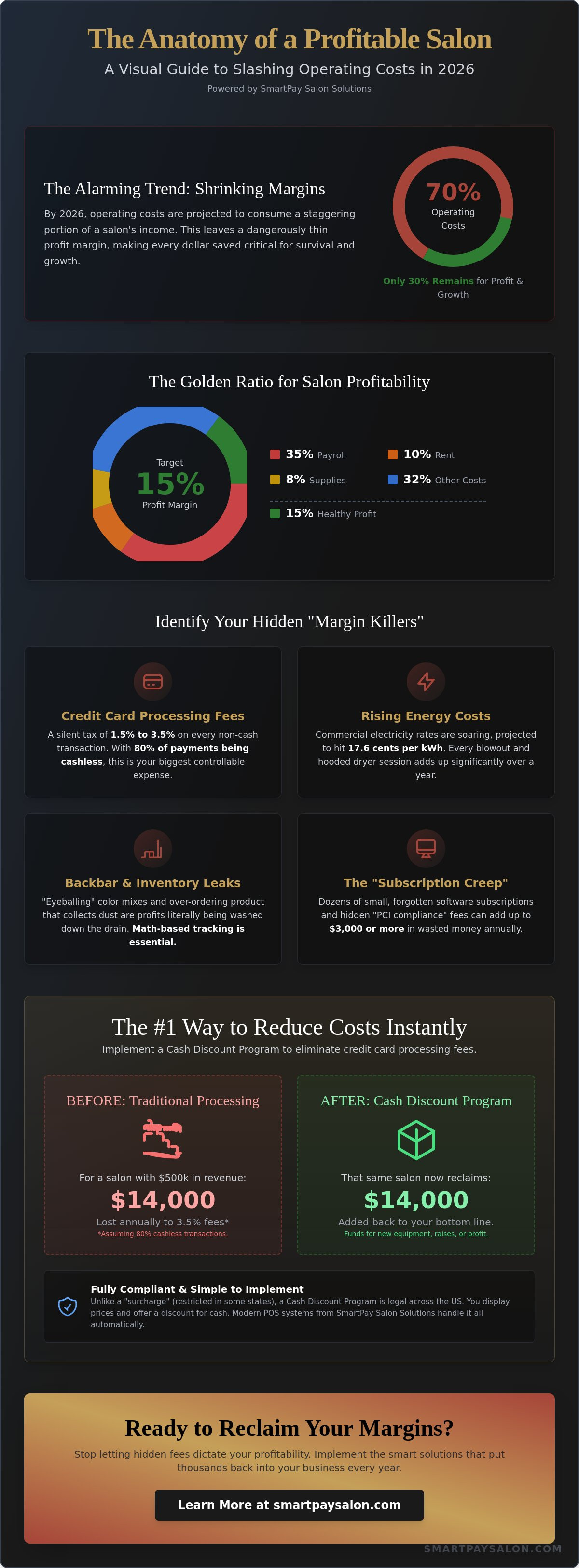
After 20 years of running salons, I've learned that waiting for a monthly P&L statement to arrive is like checking the weather after the storm has already passed. You can't change what happened three weeks ago. In 2026, where the average profit margin sits between 10% and 15%, you need a real-time pulse on your business. If you want to know how to reduce salon operating costs, you have to move beyond once-a-month bookkeeping and start looking at your daily numbers with a critical eye. It's about catching the small leaks before they sink the ship.
A solid grasp of Understanding Your Salon Cost Structure is your best defense against the rising tide of inflation. Your fixed costs, like rent and insurance, are the foundation you can't easily move. However, your variable costs are where the magic happens. These are the expenses like backbar supplies and electricity, which is forecasted to hit 17.6 cents per kWh this year. Because these costs fluctuate based on how you run your floor, they represent your biggest opportunity to reclaim lost margins today.
Don't overlook the "invisible drain" either. I'm talking about those $15 and $30 monthly software subscriptions for tools you barely use, or those sneaky "PCI compliance" fees buried in a generic processor's bill. These small hits can easily add up to $3,000 or more annually. In a world where 80% of urban salon payments are now cashless, even a tiny fraction of a percentage point in processing fees can determine whether you can afford that new station upgrade next year.
The Big Three: Payroll, Rent, and Supplies
Payroll, rent, and supplies will always be the heavy hitters on your bank statement. Payroll is particularly challenging in 2026 because minimum wages in states like California and New York have climbed toward $17.00 per hour. You need to balance fair compensation with actual productivity gaps. A healthy salon should aim for a "Golden Ratio" where payroll stays at 35%, rent at 10%, and supplies at 8% of total revenue to ensure a sustainable 15% profit margin.
Identifying Your Margin Killers
Spotting leaks requires you to look past the "we've always done it this way" mentality. I've seen salons lose thousands just because stylists were "eyeballing" color mixes instead of using a digital scale. Every ounce of wasted product is money literally washed down the drain. You also have to analyze the true cost of every visit. This means factoring in the 2.6% plus $0.10 per transaction fee for in-person swipes and the cost of the electricity used for that 45-minute blowout. When you see the math, the path to how to reduce salon operating costs becomes much clearer and less emotional.
Eliminating Credit Card Processing Fees with a Cash Discount Program
Most salon owners accept merchant processing fees as an unavoidable tax on their hard work. I used to be one of them. For years, I just signed the merchant statement and grumbled about the hundreds or thousands of dollars disappearing every month. But in 2026, with processing fees for small businesses ranging from 1.5% to 3.5%, this isn't just a minor line item. It's a massive "margin killer" that you can actually eliminate. If you're looking for the single most effective way for how to reduce salon operating costs, a Cash Discount Program is your secret weapon.
The math is life-changing for a small business. Let's say your salon generates $500,000 in annual revenue. If 80% of those transactions are cashless, which is the current average for urban salons, a 3.5% processing fee is costing you $14,000 a year. For many owners, that represents a full month of take-home pay or the budget for a complete station renovation. By shifting these costs away from your bottom line, you can reclaim $15,000 to $20,000 instantly without cutting a single staff hour or switching to cheaper backbar products.
How Cash Discounting Actually Works
It's important to understand the distinction between a "surcharge" and a "cash discount." A surcharge adds a fee at the end of a credit card transaction, which is currently restricted or heavily regulated in states like Connecticut and Massachusetts. While typical salon operating costs are rising, cash discounting remains a compliant way to protect your margins. You simply display your standard prices and offer a lower price for clients who choose to pay with cash. Modern POS systems like Clover handle these calculations automatically at checkout, so your front desk staff doesn't have to play mathematician. Offering a discount for cash payments is a legally compliant practice across the United States that helps you reach near-zero processing fees.
Communicating the Change to Clients
The number one fear I hear from owners is that clients will be upset. In my 20 years of ownership, I’ve found that transparency actually builds trust. Think of it as an "over the fence" chat with a neighbor. You can simply tell your regulars, "To keep our service prices stable while product costs rise, we’re now rewarding our cash-paying clients with a discount." Most people see the price of everything from gas to groceries going up and they appreciate that you're finding ways to avoid a flat price hike. You can Learn how to eliminate your processing fees today and stop letting those small swipes eat your profit. When you explain the "why" behind the change, your loyal clients will support your efforts to keep your local business thriving.
Plugging the Leaks in Your Backbar and Inventory
I remember many mornings spent staring at a shelf full of dusty bottles, wondering why I ever bought six cases of that one-off seasonal hairspray. It’s a common sight in our industry. We often treat our backbar like an endless resource, but in 2026, every ounce of wasted product is a direct hit to your 10% to 15% profit margin. Learning how to reduce salon operating costs often starts right at the mixing station. If your stylists are still "eyeballing" their color formulas instead of using a digital scale, you are likely washing a luxury vacation's worth of profit down the drain every year.
The "Color Scale" revolution is about more than just being precise; it’s about data. When you weigh every gram, you can finally see the true cost of a service. This data gives you massive leverage when negotiating with vendors. Instead of accepting generic "pro-only" pricing, you can show your 2026 usage reports and ask for better rates on the specific tubes you actually move. Stop letting your cash sit on the shelves in the form of overstock. Transitioning to a "Just-in-Time" ordering system ensures your cash flow stays liquid, allowing you to pay for what you need this week, not what you might need three months from now.
The Backbar Audit
A successful audit begins with training your team to see product as liquid cash. It’s not about being stingy; it’s about being smart. I’ve found that when stylists understand that product waste directly impacts the salon’s ability to offer better commissions or new equipment, they buy in quickly. Implement these simple hacks to see an immediate difference:
- Install high-efficiency pumps on every liter bottle to prevent over-pouring.
- Use tube squeezers to ensure you get every last drop of color out of the packaging.
- Invest in mixing technology that aerates the color, making it go further without compromising the results.
Retail Strategy for a Leaner Salon
Stop trying to be a museum for every hair brand under the sun. Modern salon models show that retail contributes about 25% of revenue, but that only works if the inventory is moving. Focus on a few "hero" products that your team truly believes in. These high-margin items are easier to track and much easier to sell. Your POS should act as your silent partner here. Set up alerts to notify you when a hero product is low, and more importantly, use it to identify the "dusty bottles" that haven't moved in 90 days. When a product isn't selling, clear it out with a promotion and use that shelf space for something that actually pays the rent.
Optimizing Labor and Energy Efficiency
In my 20 years as an owner, I've seen how labor and utilities can quietly eat a business from the inside out. With commercial electricity rates forecasted to hit 17.6 cents per kWh in 2026, and minimum wages in states like New York reaching $17.00 per hour, you can't afford to be casual about your overhead. If you're looking for how to reduce salon operating costs, the answer isn't just cutting hours. It's about making every minute behind the chair count. Running a lean staff shouldn't mean your team is stressed. It means using data to ensure your stylists are busy when they're on the clock and resting when they're not.
The "Gap" problem is a silent profit killer that many owners overlook. Those 15-minute holes in your book might feel like a nice coffee break, but they are actually lost revenue. If you have five stylists with just two 15-minute gaps a day, that's over 12 hours of wasted station time every month. By tightening your scheduling and matching your staff levels to actual client demand, you can reclaim that lost time. It's about working smarter and ensuring your book is as dense as possible to maximize your square footage.
Maximizing Stylist Productivity
Encouraging your team to pre-book every client is the most effective way to stabilize your future revenue. When a stylist's book is 80% full before the week even starts, they feel secure and productive. Assistants also play a huge role here. By utilizing an assistant to handle shampoos and prep, you increase your "chairs per hour" capacity. Increasing your stylist utilization by just 5% can boost your bottom line by thousands of dollars annually without adding a single new employee.
Reducing Utility Overhead
Utilities are another area where small changes yield big results. I've found that smart thermostats and LED lighting can drop a monthly bill by 10% almost immediately. These upgrades often pay for themselves within the first six months. Don't forget about the shampoo experience either. You can install high-pressure, water-saving nozzles that reduce consumption by 30% without your clients ever noticing a drop in luxury. Even your laundry routine deserves a look. For some, outsourcing towels is a lifesaver; for others, a high-efficiency in-house machine is the way to go. You can partner with a profitability consultant to audit these hidden expenses and find the right balance for your specific location.
The Smart Salon Tech Stack: Investing to Save
I’ve seen plenty of owners cling to their old software like a favorite pair of shears that’s long overdue for sharpening. A 10-year-old POS system isn't just a bit slow; it's likely costing you thousands in missed data and fragmented workflows. If you’re serious about how to reduce salon operating costs, your tech stack is the place to start. Modern systems like Clover and SumUp are built for salons, not just general retail. They unify your booking, inventory, and payments into one smart dashboard, so you don't have to jump between five different apps just to see if you had a profitable Tuesday.
When you have everything in one place, the "invisible drains" we discussed earlier become visible. You can see exactly which stylists are pre-booking and which retail products are actually moving. This isn't just about bells and whistles; it’s about having a command center that replaces chaos with smart simplicity. If you’re tired of the "Stripe headaches" and generic processors that don't understand the beauty world, switching to a unified system is the fastest way to stabilize your business. It's the same strategy I used to keep my salons profitable for over 20 years.
Choosing Hardware That Works for You
The right hardware should fit your specific salon footprint. The Clover Station Duo is a powerhouse for a high-traffic front desk, offering a sleek look and a customer-facing screen that makes checkout feel professional. If you prefer a more intimate experience or have a smaller space, the Clover Flex allows you to handle the entire checkout process right at the station. For those who are already committed to their current software, a Square integration can help bridge the gap between your booking and your merchant account. These modern tools significantly reduce human error at the front desk, ensuring that every add-on service and retail bottle is accounted for correctly every single time.
Your Path to a More Profitable 2026
I know you're busy. Between managing staff and keeping clients happy, spreadsheets are often the last thing on your mind. That’s why profitability consulting is such a game-changer for owners who want to know how to reduce salon operating costs without spending all night in the office. It’s about having a partner who can look at your numbers with a fresh set of eyes and find the savings you’re too exhausted to see. I challenge you to take a 30-day window to implement just two of the strategies we’ve covered. Whether it’s starting a Cash Discount Program or finally upgrading your hardware, the "set it and forget it" mentality is the secret to long-term sanity. You can Get a free salon profitability consultation and see where you can save to start reclaiming your margins today. Built for Salons. Powered by Smart Technology.
Take Control of Your Margins and Your Future
Running a salon in 2026 isn't just about doing great hair; it's about mastering the math behind the chair. We have looked at how reclaiming the 3.5% lost to processing fees and tightening your backbar inventory can save you thousands of dollars annually. When you move beyond once-a-month spreadsheets and embrace a smart tech stack, you stop reacting to your bills and start controlling them. You have worked too hard to let fragmented software or merchant fees eat your margins.
With 30 years of industry expertise and two decades as an owner, I've seen every "headache" the beauty world can throw at you. That's why I focus on specialized Square and Clover integrations that actually work for our unique workflow. You don't have to navigate these rising costs alone. Dedicated salon profitability consulting can help you pinpoint exactly where your money is leaking so you can get back to focusing on your clients. It's time to stop letting hidden fees dictate your take-home pay. I am here to help you figure out exactly how to reduce salon operating costs so your business can thrive for years to come.
Stop overpaying and start growing; click here for your custom Salon Savings Plan
You've built something beautiful. Now, let's make sure it stays profitable.
Frequently Asked Questions
How much can I realistically save by switching to a Cash Discount Program?
You can save 100% of your credit card processing fees, which typically range from 1.5% to 3.5% per transaction. For an urban salon doing $500,000 in revenue, this adds up to roughly $14,000 to $17,500 annually based on 2026 cashless trends. This program shifts the cost of acceptance away from your bottom line. It essentially gives you a massive raise without needing to increase your service prices.
Is it legal to pass credit card fees to clients in my state?
Yes, offering a discount for cash payments is legal in all 50 states as of May 2026. While surcharging has restrictions in states like Connecticut and Massachusetts, the Cash Discount Program is a compliant alternative. It rewards clients for choosing cash while keeping your listed prices stable. Always ensure your POS system and signage clearly communicate the two-tier pricing to remain fully compliant with federal guidelines.
What is the most effective way to track backbar waste without micromanaging stylists?
Using a digital scale at the mixing station is the most effective, hands-off method to reduce waste. Instead of checking every bowl, you set a "cost-per-gram" standard in your system. This allows you to see usage reports that highlight if a specific service is consistently over-poured. It's about using technology to empower your team to value the product rather than standing over their shoulders with a clipboard.
Will my stylists lose tips if I change my payment processing system?
No, modern systems like Clover and SumUp actually make tipping easier and more transparent for both the client and the stylist. In fact, urban salons report that 80% of payments are now cashless, and digital tip prompts often increase the average tip percentage compared to cash. A smart processing system ensures tips are recorded accurately. It can even be set to pay out daily to keep your team motivated.
How do I know if I need to upgrade my salon POS hardware?
You should upgrade if your current system doesn't offer integrated inventory tracking or if it's over five years old. Older hardware often lacks the security features required for 2026 compliance and can't run the AI-powered re-engagement tools that drive modern growth. If your front desk is juggling three different tablets to handle booking, payments, and SMS marketing, it's a clear sign your hardware is costing you time and money.
Can I keep my existing booking software if I switch to SmartPay Salon Solutions?
Yes, we specialize in Square and Clover integrations that allow you to keep the booking software you love while enjoying lower processing costs. You don't have to tear down your entire workflow to learn how to reduce salon operating costs. We simply plug our smart technology into your current setup to eliminate "Stripe headaches" and generic fees. This gives you the best of both worlds without the migration stress.
What are the most common "hidden" costs salon owners overlook?
Small recurring software subscriptions and "PCI compliance" fees are the most common overlooked expenses, often totaling $3,000 annually. Many owners also miss the impact of rising energy rates, which are forecasted to hit 17.6 cents per kWh this year. These small, automatic deductions feel minor individually. They act as a "slow leak" in your profit margin that can be easily plugged with a quick audit.
Is it better to rent or buy salon equipment to keep operating costs low?
Buying equipment is generally better for long-term profitability, though leasing can help manage initial cash flow for major renovations. When you own your stations and chairs, you eliminate a permanent monthly expense that eats into your 10% to 15% profit margin. In 2026, many owners use the savings from their Cash Discount Program to fund equipment purchases outright. This avoids high-interest debt and keeps your overhead as lean as possible.