

Imagine sitting down at your breakroom table on a Tuesday night. You're looking at your processing statement and realizing that $1,200 in "miscellaneous" fees just walked out the door. That's the equivalent of a senior stylist’s weekly commission, gone before you even paid rent. If you've ever wondered why your bill is so high when your promised rate was 2.6%, you aren't alone. Mastering the art of avoiding hidden fees in merchant services is the fastest way to give yourself a raise without adding a single blowout to the books.
I've spent 30 years in the beauty industry and 20 years behind the owner's desk, so I know exactly how frustrating those complex, jargon-filled statements feel. You deserve a transparent monthly bill and lower overhead that doesn't require raising your prices on loyal clients. I'll show you how to leverage the 2026 Visa-Mastercard settlement to your advantage, spot those $25 monthly "junk" fees, and decide if a cash discount program is the right move for your growth. We'll break down the new 1.25% rate caps and the real cost of "simple" flat-rate traps so you can finally keep what you earn.
Key Takeaways
- Stop letting "Greek" statements hide your hard-earned profit and learn how to translate bank jargon into a clear picture of your salon's financial health.
- Master the professional secrets to avoiding hidden fees in merchant services by identifying the "Big 6" junk charges that act as a silent tax on every service.
- Discover why the "simple" flat-rate pricing offered by big tech platforms is often a profit center for them rather than a savings tool for your business.
- Use our practical 5-step audit checklist to uncover your true effective rate and recover thousands in lost revenue without raising your service prices.
- Explore how a compliant Cash Discount Program can help you move beyond fee avoidance to eliminate your processing overhead entirely.
Why Your Salon Statement Looks Like Greek (and Why It Matters)
I have been exactly where you are, sitting in the back room with a coffee that's gone cold, staring at a stack of papers that might as well be written in ancient Greek. Most folks think merchant services just means that little plastic box on your counter where clients tap their cards. In reality, Understanding merchant accounts is about knowing how every dollar your clients pay for a balayage or a trim actually travels to your bank. Banks and processors love to keep these statements confusing because it's much easier to hide a "markup" when you can't tell your interchange from your assessments.
I remember digging through a dusty ledger from my salon back in 2004 and finding a recurring $500 "Account Integrity" fee. I had been paying it every single month for three years without a clue what it was for. It turns out, it was just a mystery fee the bank added because they could. That realization changed how I looked at my business. Mastering the art of avoiding hidden fees in merchant services isn't just about being frugal; it is about reclaiming the profit that belongs to your family and your stylists. With the 2026 Visa-Mastercard settlement finally introducing a 10-basis-point reduction in rates, this is the year you have to stop accepting "standard" as the status quo.
The Three Layers of Every Transaction
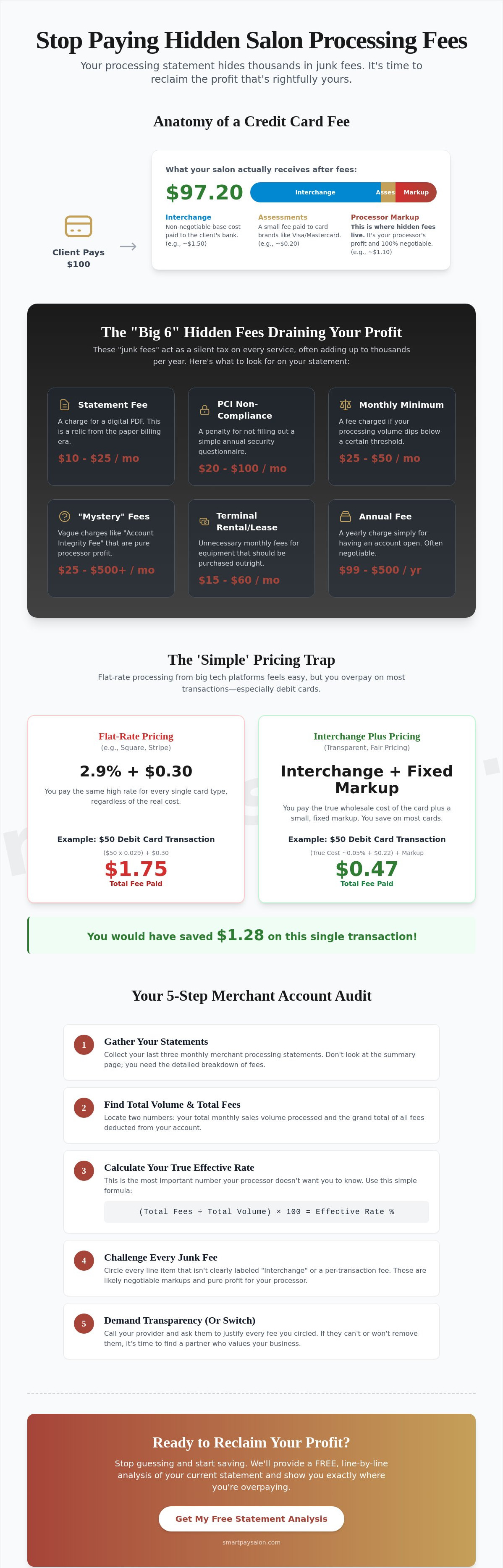
Every time a card swipes, the fee you pay is actually split into three distinct buckets. First is the Interchange, which is the non-negotiable base cost set by the banks. Second is the Assessment, a tiny slice taken by the card brands like Visa or Mastercard. Finally, there is the Processor Markup. This third layer is where the "hidden" fees live and where we have the most room to save you money. If you don't know the size of that third bucket, you are likely overpaying by thousands every year.
Why "Convenience" is the Most Expensive Fee
Many modern booking apps promise a "one-click" setup that feels like a dream during a busy Saturday. However, that convenience often comes with a heavy price tag. These all-in-one platforms frequently lock you into their own proprietary payment gateways, making it impossible to shop for a better deal without moving your entire appointment calendar. Bundled pricing is a convenience trap that masks true costs by lumping different interchange categories into one high, opaque rate. You might feel like you're saving time, but you're often paying a massive premium for that simplicity.
The 'Big 6' Hidden Fees Draining Your Salon’s Profit Margins
Imagine opening a shipment of backbar supplies and seeing a charge for three gallons of developer you never ordered. You'd call the rep immediately, right? Yet, most salon owners pay the merchant services equivalent of that every single month without blinking. These "junk" fees are the silent killers of your profit margins. They act as death by a thousand cuts; a $15 fee here and a $40 penalty there quickly add up to the cost of a new styling chair or a high-end education course. Avoiding hidden fees in merchant services starts with knowing which charges are legitimate bank costs and which are just creative ways for a processor to pad their own pockets.
During my 20 years as an owner, I learned that banks count on us being too busy behind the chair to audit every line item. While some costs like interchange are set in stone, most administrative fees are entirely negotiable or removable. If you see a fee that doesn't look like a direct transaction cost, it's likely a markup. It’s like paying for backbar supplies you never ordered; if you don't speak up, they'll keep shipping them and keep charging you.
Administrative "Junk" Fees to Watch
First, look for the Statement Fee. In 2026, there's no reason to pay $10 to $15 a month for a digital PDF you download yourself. It's a relic of the paper-billing era that many processors refuse to retire. Next is the PCI Non-Compliance fee. This is a penalty, often ranging from $10 to $100 per month, charged because you haven't completed a simple annual security questionnaire. It's a massive profit center for banks. The Federal Trade Commission's Rule on Hidden Fees has put a spotlight on these types of deceptive practices, but many processors still hope you won't notice. Finally, watch out for Monthly Minimums. If your salon has a slow month or you're a solo booth renter, some companies will charge you an extra fee just because you didn't process enough volume.
Technical and Transactional Surcharges
Then we have the "per-click" costs. Batch Header Fees are charged every time you close out your terminals at the end of the day. If you have five stylists closing five separate drawers, those nickels and dimes add up. Non-Qualified (Non-Qual) fees are even more frustrating. If a client uses a high-end rewards card or a corporate card, your processor might "downgrade" the transaction, adding an extra 1.5% or more to the cost. Lastly, Gateway Fees are the "toll booth" charges for taking payments through your website or booking app. If you're feeling overwhelmed by these line items, it might be time to look into salon profitability consulting to see where your money is actually going. Most of these administrative markups can be eliminated with the right partner who understands the beauty industry.
The 'Simple' Pricing Trap: Why Flat-Rate Processing Costs You More
We all love the idea of "simple." When those sleek white card readers first hit the market, I thought they were a godsend for busy owners. But after 30 years in the beauty industry, I've learned that "simple" is often code for "expensive." That flat rate of 2.6% + $0.10 sounds great on a brochure, but it is actually a massive profit center for the tech giant, not your salon. It's what I call the "Integration Tax." You're essentially paying a premium because your booking software makes it easy to click "accept" during setup. Mastering the art of avoiding hidden fees in merchant services requires you to look past the "all-in-one" marketing and see the math for what it is.
The secret that big tech platforms don't want you to know is that they aren't charging you based on what a transaction actually costs. They're charging you a "worst-case scenario" rate on every single client. When you decouple your software from your processing, you stop paying that convenience premium and start keeping the profit that usually disappears into the cloud.
Flat Rate vs. Interchange-Plus
Let's look at a $150 balayage service. With a flat rate of 2.6% + $0.10, you pay $4.00 in fees every single time. However, under the 2026 interchange rules, if that client pays with a standard Visa debit card, the actual bank cost is only 0.05% + $0.22. On an Interchange-Plus model, you'd pay that base cost plus a small, transparent markup. Instead of $4.00, your cost could be closer to $0.50. That is a $3.50 difference on just one service. Flat-rate pricing assumes every card is the most expensive one. Over a busy Saturday with 20 clients, that "simple" trap could be costing you enough to cover a stylist's daily booth rent.
The Software Lock-In Dilemma
I hear about this software lock-in dilemma constantly from owners who feel tied to their existing booking apps. You love the interface and the way it handles your calendar, but you hate seeing your hard-earned money vanish into high processing fees. The good news is that you don't have to throw the baby out with the bathwater. You can keep the software your team already knows and simply switch the "plumbing" underneath it. By partnering with SmartPay Salon Solutions, you get the best of both worlds: the familiar interface you like and the wholesale rates you deserve. It's about taking control of your overhead without disrupting your daily workflow.
How to Audit Your Merchant Account: A 5-Step Checklist for Owners
Grab a highlighter and a cup of coffee; we’re going hunting for your money. I used to do this every first Saturday of the month at my salon before the first client arrived. It is the only way to stay on top of what you are actually paying. Most owners get caught up in the "advertised rate" they were promised years ago, but that number is usually a fantasy. Avoiding hidden fees in merchant services requires you to ignore the marketing and look at the hard math on page three of your statement. If you don't look, the bank assumes you don't care.
When you call your bank to negotiate, they will often offer a tiny fraction of a percent to keep you quiet. Usually, this negotiation fails because they aren't fixing the underlying structure of your plan. They are just putting a band-aid on a broken system. You need to know exactly where the leaks are before you can plug them. It is much easier to have a conversation with your provider when you have the "ghost" fees circled in bright yellow.
Calculating Your True "Effective Rate"
The only number that truly matters is your Effective Rate. You can find this by taking your Total Fees and dividing them by your Total Processing Volume. For example, if you processed $50,000 last month and your total fees were $1,850, your effective rate is 3.7%. If that number is over 3.5%, it is a major red flag for a modern salon in 2026. This often happens because of "Tiered" pricing traps. Your bank might show a low "Qualified" rate for basic debit cards, but then they hit you with "Mid-Qual" or "Non-Qual" surcharges for rewards cards. These hidden buckets can eat an extra 1.5% of your margin instantly without you ever seeing a rate increase notice.
Spotting the "Ghost" Fees
Next, look for "Annual Fees" or "Regulatory Fees" that seem to appear out of thin air. These weren't in your original contract, but they sneak in through "policy updates." Another huge drain is the "Equipment Lease." I once met an owner paying $40 a month to lease a terminal that only costs $300 to buy outright. Over a four-year contract, that is nearly $2,000 for a basic piece of plastic. You should also scan for "Account Maintenance" charges. These provide zero value to your daily operations and are simply pure profit for the processor. If you want a professional eye to help you spot these drains, I recommend starting with a fresh merchant account setup to ensure your foundation is solid and transparent from day one.
Beyond Fee Avoidance: How to Eliminate Processing Costs Entirely
I wish I had this tool when I was running my three locations; it’s a total game-changer for your bottom line. We've spent a lot of time talking about avoiding hidden fees in merchant services, but what if you could stop playing defense entirely? Instead of just trying to lower your monthly bill, you can actually eliminate those processing costs by shifting the way you look at your service menu. This isn't about being pushy or nickel-and-diming your guests. It's about protecting your business and rewarding your clients who choose to pay with cash or a gift card. It's a strategy that turns your biggest overhead expense into a reinvestment fund for your team.
The psychology here is very different from a standard credit card surcharge, which can sometimes feel like a penalty to the client. With a Cash Discount Program, a small service fee is already built into your listed prices, and you simply offer a discount to anyone who pays with cash. It feels like a "thank you" to the client rather than an extra tax. Since dual pricing is a compliant option in all 50 states as of 2026, you can rest easy knowing your salon is following all the latest regulations while you focus on growth.
The Cash Discount Revolution
In 2026, 35% of small businesses report using some form of surcharging or cash discounting to manage their overhead. The beauty of this model is that it is 100% legal and transparent. Your stylists don't have to explain complex math at the front desk because the software handles it all. You're simply giving your guests a choice. I've seen salons recover thousands of dollars a year this way, money that usually goes straight to bank executives. It's the ultimate growth engine for an owner who wants to reinvest in their team or upgrade their backbar without taking a hit to their own take-home pay.
Choosing the Right Hardware and Support
Implementing this change requires the right tools to keep things seamless for your stylists and guests. Modern POS hardware like the Clover Station Duo or the Clover Flex makes this transition incredibly simple. These devices show the cash price and the card price clearly on the screen, so there are never any surprises at checkout. But it's about more than just a terminal. You need a partner who provides genuine Salon Profitability Consulting to help you set your prices correctly and train your team on how to talk about it. See how the Cash Discount Program can eliminate your fees today. By pairing smart technology with a strategy built specifically for the beauty industry, you can finally stop worrying about bank fees and start focusing on your next big expansion.
Reclaim Your Profit and Fuel Your Salon's Growth
You've worked too hard building your brand and training your team to let "junk" fees quietly drain your bank account every month. We've looked at how to decode those complex statements, why that "simple" flat rate is often a trap, and how a 100% transparent cash discount program can actually zero out your processing costs. Mastering the art of avoiding hidden fees in merchant services is about more than just saving a few dollars; it's about having the capital to invest in that new color line or the advanced education your stylists are asking for.
I've spent 30 years in this industry and 20 years as an owner, so I know that your time is best spent behind the chair or leading your team, not fighting with a bank. Whether you need a specialized Square or Clover integration or a complete merchant account overhaul, you don't have to navigate this alone. Let's take a look at your current statement together and find where your money is hiding. You deserve a partner who understands that every dollar saved is a dollar you can put back into your salon's culture.
Get a Free Salon Profitability Audit and Stop Paying Hidden Fees
Your salon's best years are still ahead of you. It's time to stop paying for corporate convenience and start keeping what you earn.
Frequently Asked Questions
What is a "good" credit card processing rate for a salon in 2026?
A good effective rate for an established salon in 2026 typically falls between 2.25% and 2.8%. The May 2026 antitrust settlement brought average credit card interchange rates down to approximately 2.25%. If your total fees divided by your total volume results in a number higher than 3.5%, you're paying too much. You should aim for a transparent model that passes those settlement savings directly to your bank account.
Can I keep my current salon booking software if I switch merchant providers?
You can absolutely keep your current software in most cases by using a specialized integration. Many salon owners prefer the interface of Square or their specific booking app but want to avoid the high "all-in-one" pricing. A Square Integration allows you to keep your existing calendar and client history while switching the "plumbing" to a more cost-effective processor. This gives you the best of both worlds.
How do I know if my merchant service provider is charging me hidden fees?
You can identify hidden fees by looking for non-transactional line items on your statement like "PCI Non-Compliance" or "Statement Fees." Common red flags include penalties ranging from $10 to $100 or monthly charges for digital statements. Avoiding hidden fees in merchant services requires a monthly audit of these administrative markups. If you see a fee you didn't agree to in your original contract, it's likely a hidden charge.
Is a Cash Discount Program the same as a surcharge?
A Cash Discount Program is the opposite of a surcharge because it offers a reward for cash rather than a penalty for plastic. Surcharging adds a fee at the point of sale, which is restricted or prohibited in various jurisdictions, with regulations constantly evolving. In contrast, a Cash Discount Program is compliant across the nation because it presents a lower price for cash guests. It's a much friendlier conversation to have at the front desk.
Will my salon clients be upset if I start a Cash Discount Program?
Most guests won't mind at all if you communicate the change clearly and reward them for their choice. In fact, 35% of small businesses successfully used these programs in 2026 with very little pushback from their regulars. I've found that clients appreciate the transparency. They'd rather see a "cash reward" on the screen than see you raise your haircut prices by five dollars across the board to cover bank fees.
What should I do if I find an "Early Termination Fee" in my contract?
You should first ask your new provider if they offer a contract buyout to cover that cost. Many processors will pay that fee for you because they know the long-term savings will justify the investment. Don't let a $300 or $500 exit fee keep you locked into a contract that is costing you thousands every year. It's almost always worth the one-time cost to find a partner who values transparency over fine print.
How long does it take to switch to a more transparent merchant service?
The entire process usually takes less than a week from the time you sign your new application. Your new hardware, such as a Clover Mini or Flex, can be programmed and shipped to your door in about 3 business days. You can keep your old system running right up until the moment you plug in the new one. This ensures you never miss a client payment or a stylist's commission during the transition.
Why do salon-specific processors offer better rates than big banks?
Specialized processors understand that salons have a high volume of debit transactions and a very low risk of fraud. Big banks use a "one size fits all" model that doesn't account for the unique way we handle tips and stylist commissions. Avoiding hidden fees in merchant services is much easier with a partner who has tailored their risk models specifically to the beauty industry. It's about having a specialist in your corner who knows how a busy Saturday flows.