
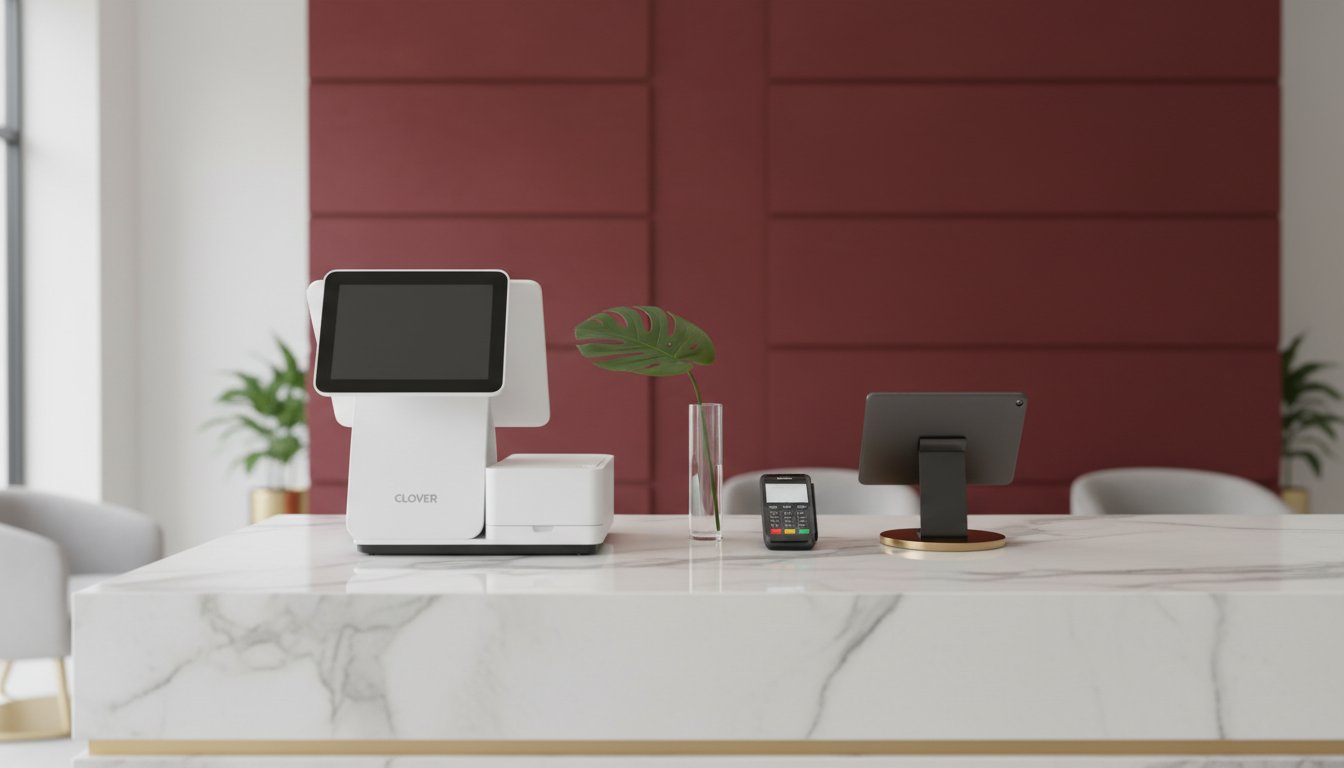
The sleekest terminal in the world won't save your sanity if it crashes during a double-booked Saturday morning. You might think the most expensive hardware is the "premium" choice, but after 30 years in the beauty world, I've seen that the best system is simply the one that doesn't cause a scene. When weighing the Clover station vs Sum Up for salons, it's easy to get distracted by flashy screens. For us, the real issue is whether we're losing 3% of every haircut to fees or if our hardware looks like a clunky eyesore on a high-end front desk.
I know the frustration of watching your hard-earned profits disappear into processing "black holes" while you're just trying to manage staff tips and booking schedules. I'm going to help you discover which POS handles the salon chaos best, from a veteran owner's perspective. We will look at why SumUp holds a 90% user satisfaction rating as of March 2026 and whether the Clover Station Solo, which currently ranges from $1,699 to $1,799, is worth the investment for your specific workflow.
Key Takeaways
- Match your front-desk aesthetic to your brand by choosing between Clover's "Command Center" duo or SumUp’s minimalist, mobile-friendly design.
- Evaluate the software depth of Clover station vs Sum Up for salons to ensure your booking, tip management, and booth renter tracking run seamlessly.
- Stop losing profits to "Stripe Headaches" and flat-rate traps by understanding the hidden costs of processing fees and long-term contracts.
- Simplify your daily operations with smart tools that handle salon-specific chaos, from automated marketing to individual staff permissions.
- Find your perfect match based on your volume, whether you need a robust management engine or a simple, portable payment tool.
The Salon POS Dilemma: Why Your Choice Impacts More Than Just Payments
I started in this industry 30 years ago when "the front desk" was nothing more than a massive paper appointment book and a calculator that probably belonged in a museum. Back then, we didn't worry about software updates or cloud syncing; we just worried about having enough pens. Times have changed. Your Point of Sale (POS) system is no longer just a way to take money. It is the very last impression a client has of your brand. If a client spends three hours getting a flawless $300 balayage only to have the checkout process feel clunky or unprofessional, that's the feeling they take out the door. A generic system that doesn't understand salon workflows can cost you more than just transaction fees; it can cost you client loyalty.
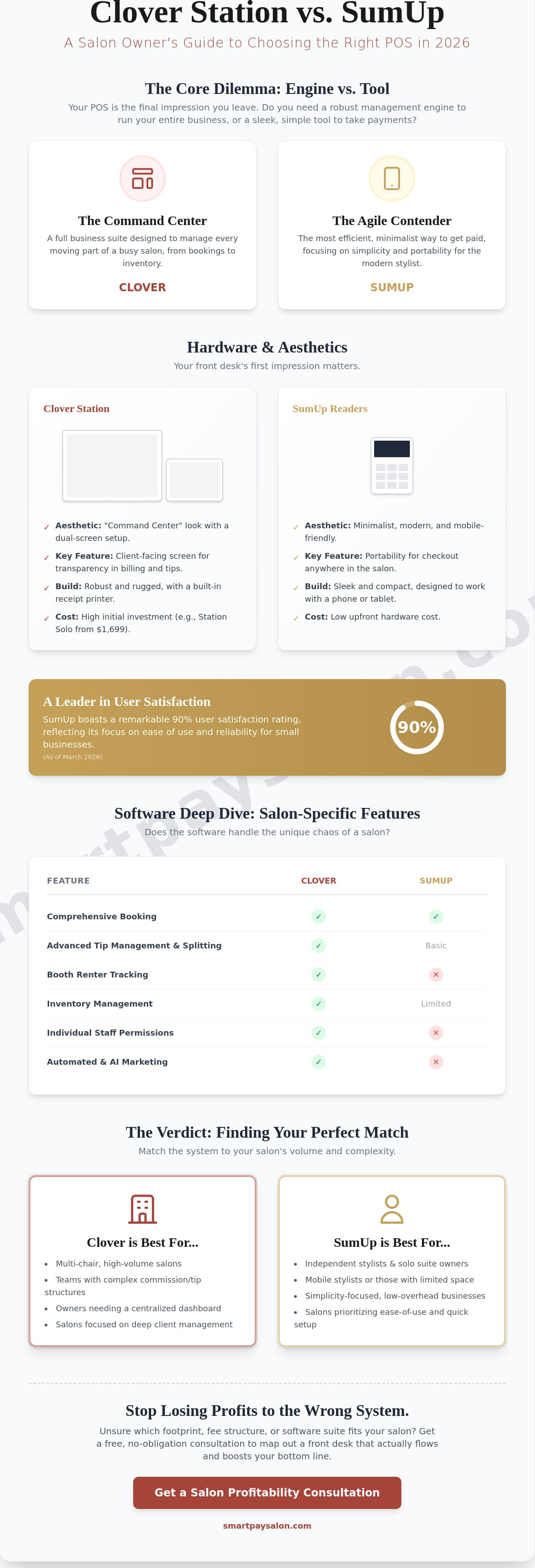
When looking at the Clover station vs Sum Up for salons, you have to decide if you want a management engine or a payment tool. Clover acts as a full business suite designed to handle every moving part of a busy shop. SumUp, which boasts a 90% user satisfaction rating as of March 2026, focuses on being the most efficient, minimalist way to get paid. Choosing the wrong one is like trying to use a flat iron to curl hair; it might eventually work, but it's going to be a struggle every single time.
The "Over the Fence" Perspective on Salon Tech
I'll never forget a rainy Saturday morning about ten years ago. We were fully booked, the hairspray was flying, and my "budget" card reader decided to stop talking to the internet. I had to ask clients to write down their credit card numbers on scraps of paper. It felt unprofessional and honestly, a bit sketchy. Reliability in a salon is different than in a coffee shop. If a barista's tablet dies, the line moves slower. If a salon's system dies, you lose track of complex formulas, future bookings, and staff commissions. You need a "stylist-proof" interface that works as hard as you do on your feet.
Defining Your Salon’s Needs for 2026
Are you a solo suite owner or are you managing a 10-chair powerhouse? In 2026, a "swipe and go" mentality is a recipe for stagnation. Modern clients expect a unified experience. Clover currently holds a 6.46% market share because it integrates everything from inventory to AI-powered re-engagement. If you have a large team, you need that centralized dashboard to keep the chaos at bay. However, if you're an independent stylist, the simplicity of SumUp's "Connect Lite" plan might be the perfect fit for your overhead. Your choice should reflect where you want your business to be by the end of the year, not just where it is today.
Deep Dive: Clover Station vs. SumUp Hardware for the Modern Stylist
When you're standing at your station for ten hours a day, the last thing you want to deal with is hardware that feels like a toy. I've seen plenty of stylists try to save a few dollars by using a basic card reader stuck into a phone, but that rarely lasts. When comparing the Clover station vs Sum Up for salons, you have to look at the physical reality of your front desk. Is it a high-traffic hub where three people are checking out at once, or is it a quiet corner in a private suite? The hardware you choose sends a message about your level of professionalism before you even say hello.
The process of accepting credit card payments should be invisible to the client. They should tap their card and go. However, for us, that hardware has to survive a battlefield of hair clippings, fine-mist hairspray, and the occasional splash of developer. Most tech reviewers forget that "salon-proof" is a very real requirement. If you aren't sure which footprint fits your layout, a quick salon profitability consultation can help you map out a front desk that actually flows.
Clover Station: The Heavyweight Champion
The Clover Station Duo is what I call the "Command Center." It's a beast. The dual-screen setup is its biggest win because it allows for total transparency. Your client sees their itemized list and tip options on their own screen while you keep your schedule and client notes private on yours. It has a built-in receipt printer, which keeps your desk clutter-free. If you want to offer checkout right at the chair, the Clover Flex is the perfect companion. It's rugged, fits in your hand, and handles the "hair in the charging port" issue better than most handhelds I've tested over the last 20 years.
SumUp: The Agile Contender
If you're a minimalist or a mobile stylist, SumUp is your best friend. It’s cordless, sleek, and takes up almost zero space. You can go from unboxing the device to taking your first payment in about ten minutes. It’s perfect for boutiques where the "front desk" is just a small side table. The main limitation comes when you have a massive service menu. Navigating 50 different color and cut options on a tiny screen can get tedious during a rush. It’s a fantastic, reliable tool, but it doesn't quite offer the "all-in-one" authority that a full Clover Station provides for a 10-chair shop.
The Veteran's Durability Check
Hairspray is the silent killer of POS hardware. It creates a sticky film on touchscreens that makes them less responsive over time. In my experience, Clover's glass surfaces wipe clean much easier than the matte plastics found on cheaper readers. Also, consider the receipt printer. Clover’s printer is tucked away, while some SumUp configurations require a separate Bluetooth printer. Fewer wires always mean fewer headaches when you're trying to keep a high-end aesthetic.
Software and Integration: Managing Bookings, Tips, and Booth Renters
The hardware might be the face of your front desk, but the software is the brain that keeps your stylists paid and your taxes accurate. I've spent two decades as an owner, and I can tell you that a beautiful terminal means nothing if it makes commission day a nightmare. When comparing the Clover station vs Sum Up for salons, you're really choosing between a deep, customizable ecosystem and a streamlined, "ready-to-go" tool. The right fit depends heavily on your business model. Are you running a traditional commission shop, or are you managing a collection of independent booth renters?
In a commission-based salon, you need granular data. You're tracking product usage, tiered commission rates, and tiered pricing based on stylist seniority. Clover’s "Register" plan, which costs $49.95 per month as of February 2026, offers the inventory management and detailed reporting necessary for this. For booth rental setups, the dynamic changes. You need a system that keeps everyone’s money separate while maintaining a unified brand at the door. SumUp’s Connect Lite plan ($99/month) provides a clean customer database and appointment management that works well for smaller, more autonomous teams.
The Clover App Ecosystem for Salons
Clover’s strength lies in its massive library of specialized apps. You can find tools specifically built for hair salons that track color formulas and client visit history. This level of detail ensures that if a stylist leaves, the client's formula stays with the house. Managing a team of ten requires unique permissions; you don't want every junior stylist seeing your total monthly revenue. Clover’s API allows for deep salon customization, letting you build a digital workflow that mirrors your physical one. If you already love your current booking software, we often help owners with Square integration to bridge the gap between their favorite apps and new hardware.
SumUp’s "Less is More" Philosophy
Not every owner wants to spend their Sunday night troubleshooting app integrations. SumUp is built for the professional who values simplicity above all else. It "just works" right out of the box. While it lacks the massive app store of Clover, it integrates seamlessly with basic accounting tools like QuickBooks. This is a lifesaver for solo suites or small boutiques. You won't find AI-powered re-engagement here, but you will find a reliable interface that makes taking a payment and prompting for a tip as fast as possible. The reality is that for some, manual entry for a few complex tasks is worth the trade-off for a system that never feels overwhelming.
Handling the "Tip Headache" is where both systems shine compared to old-school terminals. Both Clover and SumUp offer customizable tip prompts on the client-facing screen. This takes the awkwardness out of the transaction. In my experience, switching to a modern tip prompt can increase staff gratuities by up to 15% simply because the math is done for the client. Whether you need the robust management of Clover or the agile simplicity of SumUp, the goal is to spend less time on the screen and more time behind the chair.
Calculating the Real Cost: Beyond the Processing Fees
Let’s talk about the money. I’ve sat at my kitchen table enough nights with a calculator to know that a "low rate" isn’t always what it seems. When you look at the Clover station vs Sum Up for salons, the hardware price is just the entry fee. A Clover Station Duo can run up to $2,099 as of February 2026, while SumUp often provides a lower barrier to entry with their "Launch Offers." However, the real drain on your bank account isn't the terminal; it's the 2.3% to 2.6% you lose on every single transaction. Over a year, that’s not just "the cost of doing business." It’s the cost of a new car or a salon renovation.
I call this the "Stripe Headache." It's that sinking feeling when you realize you're paying thousands a year just for the privilege of taking a credit card. Flat-rate processing feels simple, but for a high-volume salon, it’s a trap that eats your margin. If you’re doing $40,000 a month in services, losing nearly 3% means you're handing over $1,200 every month. That is money that should be in your pocket or your stylists' commissions.
The Power of the Cash Discount
There is a better way to handle these fees. My favorite "over the fence" secret is the Cash Discount Program. It allows you to pass those processing costs to the client in a way that is legal, professional, and transparent. You might worry that clients will complain, but in my 20 years as an owner, I’ve found that salon clients are incredibly accepting of this model. They understand that small businesses are squeezed. By implementing this, most salons save between $500 and $2,000 a month in fees. You can calculate your potential savings to see how much of your service price you could actually be keeping.
Hidden Costs to Watch Out For
Before you sign a 36 or 48-month Clover contract, you need to watch out for "app subscription creep." Clover’s library is great, but those $10 and $20 monthly fees for inventory or loyalty apps add up fast. On the other hand, while SumUp seems cheaper, you have to consider replacement costs. Using a consumer-grade tablet as your POS can be risky; they aren't built for the heat and chemicals of a salon. Dedicated hardware like the Clover Station is a larger investment but often lasts twice as long. Finally, always check for "Next-Day Funding." In this industry, cash flow is king. You don't want your Saturday earnings sitting in a processor's bank account until Tuesday morning.
The SmartPay Verdict: Finding Your Perfect Salon Match
Choosing between the Clover station vs Sum Up for salons shouldn't feel like a high-stakes gamble. After 20 years of managing staff and watching the front desk evolve, I've learned that the "best" system is simply the one that lets you focus on your clients instead of your cables. If you are running a high-volume boutique with a large team, Clover is your management engine. Its ability to handle complex commissions and deep inventory makes it the clear winner for shops that need a centralized "Command Center." It currently holds a 6.46% market share for a reason; it’s built to scale with a growing business.
On the flip side, I recommend SumUp for the independent suite stylist or the minimalist boutique owner. You don't always need a massive dual-screen setup to provide a professional experience. SumUp’s 90% user satisfaction rating, recorded in March 2026, proves that simplicity often wins for those who want a clutter-free reception area. It’s reliable, agile, and gets you paid without the steep learning curve of a full enterprise system. My 30 years in this industry have taught me that the device is only half the battle; the support behind it is what keeps your doors open when things go sideways.
Why We Choose Clover and SumUp for Our Clients
At SmartPay, we don't just ship you a box and wish you luck. We act as your growth partner, providing specialized salon configuration that matches your specific workflow. If you’ve spent years building your business on a specific booking platform, we handle the Square integration to ensure your favorite apps talk to your new, more profitable hardware. We provide 24/7 support from people who actually know what the sting of a "no-show" feels like. We believe your technology should be a stabilizing force, not another item on your list of headaches.
Your Next Steps to a More Profitable Salon
It is time to stop losing 3% of every haircut to generic processing fees. Whether you choose the robust Clover Station Duo or the sleek SumUp Register, your goal for 2026 should be lower overhead and a more professional checkout experience. We can help you set up your new hardware to give your space that "Grand Re-Opening" feel while keeping your profits where they belong. Ready to eliminate fees? Let’s find your perfect system together. We offer free profitability consultations to show you exactly how much you can save by switching to a system that is truly Built for Salons. Powered by Smart Technology.
Take Control of Your Salon's Financial Future
Your front desk should be the engine of your growth, not a source of daily friction. After 30 years in the beauty industry, I've seen how the right choice between a Clover station vs Sum Up for salons can transform a business. Whether you need the robust management power of Clover or the streamlined agility of SumUp, your technology must work as hard as you do behind the chair. It's about more than just a screen; it's about reclaiming your time and your profits.
We specialize in helping owners eliminate up to 100% of their processing fees through our Cash Discount Program. If you're currently using a booking app you love, our specialized Square integration experts can help bridge the gap to more reliable hardware. Don't let technical hurdles or "Stripe Headaches" keep your business from reaching its full potential. You deserve a partner who understands the nuances of salon ownership from the inside out.
Unlock Your Salon’s Savings with a Custom Clover or SumUp Quote. Let's work together to make this your most profitable year yet. You've built something beautiful, and now it's time to make sure your technology supports that legacy.
Common Questions About Salon POS Systems
Can I use Clover Station if I already use Square for my bookings?
Yes, you can keep your Square booking software while upgrading your physical hardware. Our team specializes in Square integration to ensure your schedule stays intact while you benefit from the robust features of a Clover station vs Sum Up for salons setup. We bridge the gap so you don't have to learn a whole new booking system from scratch just to save on fees.
Is SumUp professional enough for a high-end luxury salon?
Absolutely, SumUp is a favorite for minimalist luxury boutiques because of its clutter-free, cordless design. It provides a sleek, modern look that doesn't distract from your high-end decor or expensive retail displays. While Clover offers a "Command Center" feel, SumUp’s 90% user satisfaction rating as of March 9, 2026, shows it delivers the professional, reliable experience luxury clients expect.
How does the Cash Discount Program work for my stylists’ tips?
The Cash Discount Program does not reduce your stylists' tips or affect their gratuity settings. The small service fee only applies to the base price of the salon service to cover merchant processing costs. Gratuities remain 100% intact for your team, ensuring your staff stays happy while your business overhead drops by $500 to $2,000 monthly depending on your volume.
Which system is better for tracking retail inventory like shampoos and oils?
Clover is the superior choice for tracking retail inventory and managing back-bar supplies. The Clover Register plan, which costs $49.95 per month as of February 24, 2026, includes advanced stock tracking and low-inventory alerts. This prevents you from running out of best-sellers or over-ordering products that aren't moving, which is vital for maintaining a healthy profit margin.
Do I need a special internet connection for the Clover Station Duo?
You don't need a specialized connection, but a dedicated high-speed line is highly recommended for the Clover Station Duo. While it works on standard Wi-Fi, plugging it directly into an Ethernet port provides the best stability for a busy front desk. This ensures your checkout process never lags when you have a line of clients waiting during a Saturday rush.
What happens if my salon’s Wi-Fi goes down during a checkout?
Both systems offer reliable solutions for internet outages so you won't lose a single sale. The Clover Flex and Mini have built-in cellular LTE backups that kick in automatically if the Wi-Fi signal drops. SumUp also allows for offline processing in specific configurations. This means you can keep checking out clients even if your local provider has a temporary service interruption.
How hard is it to switch from my current processor to SmartPay?
Switching to SmartPay is a streamlined process that typically takes 24 to 48 hours from start to finish. We handle the merchant account setup and hardware configuration so you don't have to deal with technical headaches. Our goal is to make the transition invisible to your clients so you don't miss a single appointment during the upgrade process.
Are there any long-term contracts with Clover or SumUp through SmartPay?
Clover hardware often involves 36 or 48-month contract terms as of February 4, 2026, while SumUp typically offers more month-to-month flexibility. We help you navigate these terms to find the right fit for your business's long-term goals and budget. Our focus is on providing a stable growth partnership rather than locking you into a generic, impersonal agreement.