

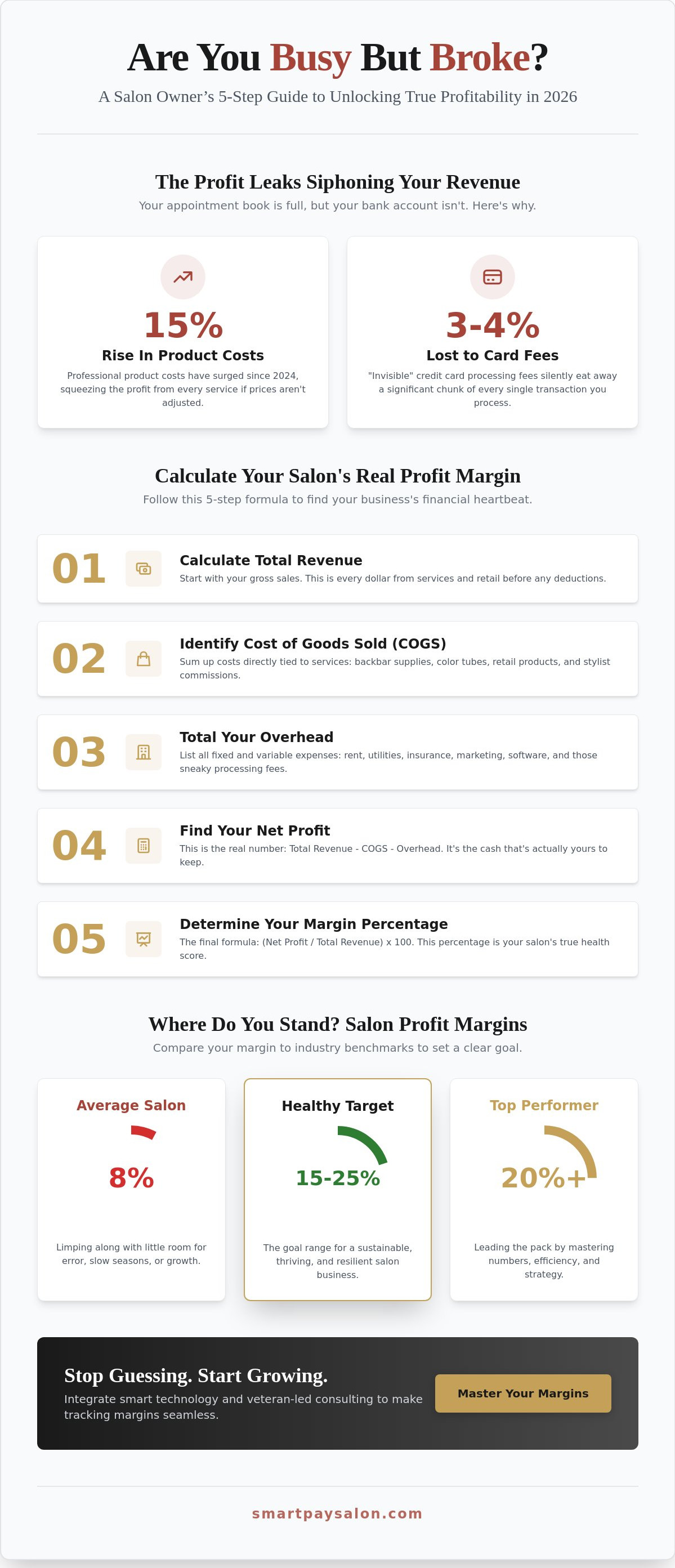
What if I told you that being "fully booked" is actually the most dangerous time for your salon's bank account? I've spent 30 years in this industry and 20 of them behind the owner's desk, so I know that feeling of a packed floor and an empty wallet. You look at your software and see a sea of appointments, but when you look at your take-home pay, the numbers just don't add up. The truth is that calculating salon profit margins in 2026 requires more than just looking at your total sales. With professional product costs rising by 15 percent since 2024 and hidden credit card fees quietly siphoning off 3 percent to 4 percent of every single ticket, your hard-earned revenue is leaking out before you can even pay yourself.
It's frustrating to feel like you're working for your business instead of it working for you. I've been there, and I promise that mastering your math doesn't have to be a headache. In this guide, I'll show you the exact formulas I use to find those hidden "profit leaks" and get your margins back into that healthy 15 percent to 25 percent range. We're going to simplify your expense tracking and build a strategy to boost your "real" take-home pay without scaring away your favorite clients. Let's get your salon's finances as polished as a fresh set of highlights.
Key Takeaways
- Master the exact 5-step formula for calculating salon profit margins to reveal your true take-home pay and overall business health.
- Identify the "Invisible Overhead" costs that act as profit leaks, including those 3 percent to 4 percent processing fees that eat into every ticket.
- Discover why the "Third Option" is often more effective than simply raising prices when you want to increase your bottom line without losing clients.
- Learn how to integrate veteran-led consulting with modern Clover hardware to make tracking your expenses and margins completely seamless.
Understanding the Veteran’s View: Why Salon Margins Matter in 2026
Think of your profit margin as the heartbeat of your business. If the pulse is weak, it doesn't matter how fast the body is moving. I've spent three decades in this industry, and I've seen too many talented owners burn out because they confused "busy" with "profitable." I remember a colleague who ran a gorgeous six chair salon in 2024. Her stylists were booked three weeks out, and the energy in the shop was electric. Yet, at the end of the month, she was consistently dipping into her personal savings to cover the backbar order. She was "busy broke," and it's a trap that's easier to fall into than ever before.
In our current 2026 economy, the old rules have changed. You can't just look at a full appointment book and assume you're making money. Most salons today are limping along with an 8 percent margin, which leaves almost no room for equipment repairs or slow seasons. My goal is to help you move toward that 20 percent "Top Performer" mark. Getting there starts with calculating salon profit margins with total honesty, looking past the gross revenue and focusing on what actually stays in your pocket.
Gross Margin vs. Net Profit: The Only Two Numbers That Truly Count
I like to keep things simple when we're talking numbers over the fence. Your Gross Margin is basically the money left over after you pay for the "ingredients" of a service, like your color tubes and your stylist's commission. It tells you if your services are priced correctly. Your Net Profit, however, is the real "keepable" cash that remains after you pay rent, utilities, and those sneaky credit card fees that steal 3 percent to 4 percent of every ticket. Net profit is the ultimate measure of an owner's freedom.
The 2026 Salon Landscape: How Inflation Changed the Math
We've all felt the pinch lately. The cost of professional grade products has risen by 15 percent over the last two years, which means your 2021 pricing strategies are likely a recipe for disaster today. If you haven't adjusted your math to account for these rising COGS (Cost of Goods Sold), you're essentially giving away your profit with every bowl of lightener you mix. This is why real time tracking is so vital now. Using a modern POS system like the Clover Station Duo allows you to see these shifts instantly. You don't have to wait for your accountant to tell you that you had a bad quarter; you can see the leak and plug it before the week is even over.
How to Calculate Your Salon Profit Margins: A 5-Step Guide
Let's sit down and look at the books together. I know that looking at a spreadsheet can feel like a chore after a ten hour day on the floor, but calculating salon profit margins is the only way to know if your passion is actually paying you back. You don't need a math degree to get this right. You just need a clear system to see where the money goes once it leaves the client's hand. Follow these five steps to find your "real" number.
- Step 1: Calculate Total Revenue. This is your Gross Sales. It's every dollar that came through the door from services and retail before anything else is taken out.
- Step 2: Identify Cost of Goods Sold (COGS). This includes your backbar supplies, color tubes, and stylist commissions. In 2026, a healthy budget for professional products usually sits between 10 percent and 15 percent of your revenue.
- Step 3: Total Your Overhead. List your fixed costs like rent and insurance, plus variables like utilities. Don't forget that cosmetology liability insurance for a solo stylist currently averages $300 to $600 per year.
- Step 4: Find Your Net Profit. Subtract your COGS and your Overhead from your Total Revenue. This is the cash that's actually yours to keep.
- Step 5: Determine Your Margin Percentage. Divide that Net Profit by your Total Revenue, then multiply by 100. That's your heartbeat.
Formula Breakdown: The Math Made Easy
Let's look at a $100 highlight service to see how this works in the real world. If you spend $15 on product and pay your stylist a $40 commission, your Gross Profit is $45. Now, you have to cover the lights, the rent, and the front desk. If your overhead for that hour is $30, you're left with $15. That’s a 15 percent profit margin. Understanding the Profit Formula helps you see that even a small shift in product waste can change that $15 into $20, which is a massive jump for your bottom line.
The "Hidden Costs" Most Owners Forget
It's the "little things" that usually sink the ship. I've seen $50 subscriptions and equipment repairs drop a margin from a healthy 15 percent down to a struggling 10 percent without the owner even noticing. You have to account for licensing fees, which can run between $300 and $800 a year, and those constant marketing software "pings." If you're feeling overwhelmed by these micro-expenses, a smart Square integration can help you track every penny automatically. Stop chasing receipts and let your technology do the heavy lifting for you.
Identifying the "Profit Leaks": Why Your Margins Are Slipping
I hear it all the time from owners who are just exhausted. They tell me, "I've cut everything I can. I can't lower my rent, and I certainly can't pay my stylists less if I want to keep them." It feels like you're stuck in a corner. But when we start calculating salon profit margins together, we usually find that the biggest leaks aren't the big bills. They're the tiny, invisible drips that happen every time a client swipes their card or a stylist mixes too much color. These are the "Invisible Overheads" that never show up on your price menu but eat your lunch every single day.
Generic processors like Stripe are built for everyone from dog walkers to tech startups. They don't understand the specific rhythm of a hair salon. Those flat rates might look simple on paper, but "Stripe Headaches" are real when you realize how much of your profit is being skimmed off the top. We need smart technology that is actually built for salons, not a one size fits all solution that treats your high ticket color service the same as a cup of coffee.
The 3% Problem: Merchant Fees and Your Bottom Line
Let's talk about that 3 percent processing fee. Most owners think, "It's just 3 percent, I can live with that." But here is the catch: that fee isn't 3 percent of your profit. It is 3 percent of your GROSS revenue. If you are running at a 10 percent margin, and the processor takes 3 percent of the total ticket, they are actually taking 30 percent of your take home pay. The average hair salon profit margin is already tight enough without giving nearly a third of your personal income to a multi-billion dollar bank. This is the most easily plugged leak in your entire business, and it doesn't require you to work a single extra hour.
Wasted Backbar and Inventory Shrinkage
The other major leak is happening right at the shampoo bowl. I call it "drain pouring." If your stylists are mixing 4 ounces of color when the service only requires 2.5 ounces, that extra ounce and a half is pure profit literally being washed away. Since professional product costs have jumped 15 percent recently, you have to be precise. I always recommend the veteran’s trick of weighing every bowl before and after the service. Modern hardware like the Clover Mini makes this easier because it helps you track your inventory in real time. When you know exactly what is on your shelves, you stop over-ordering and start keeping that cash in your bank account instead. If you're ready to stop the guessing game, our Salon Profitability Consulting can help you spot these specific leaks in your own shop.
Practical Strategies to Boost Your Margin Without Scaring Clients
Whenever I sit down with an owner to look at their books, the first thing they usually say is, "I know I need to raise my prices, but I'm terrified of losing my regulars." I've been in those shoes, and I know that pit in your stomach. But when you're calculating salon profit margins and seeing that your take-home pay hasn't moved in two years despite being busier than ever, you have to pull a lever. Most people think there are only two levers: raise prices or cut staff. I'm here to tell you there is a third option that most owners completely overlook.
The Cash Discount Model: Reclaiming Your 3%
Think of the Cash Discount Program as the "Third Option." It’s like getting a 3 percent raise overnight without having to do a single extra haircut or color service. By passing the merchant processing fees along to the transaction, you stop the bank from skimming off the top of your hard work. I know the fear of "scaring clients" is real, but let's be honest. In 2026, clients see these small business costs everywhere, from the local coffee shop to the dry cleaners. Most of your guests will understand that those fees were quietly eating 30 percent of your actual profit. When you're transparent about why you're doing it, they often feel like they're partnering in your salon's success rather than just being another ticket number.
If you're tired of watching your hard-earned money disappear into a generic processor's pocket, you can explore our Cash Discount Program to see exactly how much you can put back into your own pocket every month. It’s the simplest way to get a raise without touching your service menu.
Optimizing Your Service Menu
Another way to boost that margin is to look at what you're actually doing behind the chair. Not all services are created equal. You might have a popular service that everyone loves, but if it takes four hours and uses $50 in product, it might be costing you money once you factor in your hourly overhead. Specialized beauty services have seen a 12 percent year-over-year growth in consumer spending as of April 2026. Top-performing salons are now aiming for a 50 percent to 65 percent gross margin on high-ticket items like keratin treatments or extensions. These services use more product, but the labor-to-revenue ratio is much more favorable for your bottom line.
Don't forget the retail shelf, either. In 2026, the most profitable salons are aiming for retail to account for 15 percent to 20 percent of their total revenue. Since retail products typically have a 50 percent profit margin, it’s the fastest way to increase your average ticket without adding a single minute of labor to your day. It isn't about being a pushy salesperson; it’s about prescribing the right home care so your work stays looking beautiful until the client's next visit.
Leveraging Smart Technology for a More Profitable Salon
I spent most of my career with a pencil behind my ear and a ledger on the breakroom table. I know that calculating salon profit margins used to feel like a second job after the last client left. But we aren't in the 1990s anymore. The veteran wisdom I’ve gained over 30 years tells me that you can't manage what you don't measure. Today, we have "Smart" tools that do the heavy lifting for us, turning that pile of receipts into a clear roadmap for growth. You don't have to be a math whiz to run a profitable shop; you just need the right hardware in your hands.
If you love your current booking software but hate the "Stripe Headaches" and high fees that come with it, you don't have to start from scratch. Our Square Integration allows you to keep the workflow you're comfortable with while plugging those profit leaks we talked about earlier. It’s about making your technology work for you, not the other way around. Don't let the math scare you. Let the tools handle the data so you can get back to what you love: making people feel beautiful.
Clover and SumUp: Hardware Built for Beauty
The right hardware is an investment in your margin, not just another expense on your list. The Clover Station Duo is a workhorse that handles complex salon workflows without breaking a sweat. It unifies your appointments and payments into one centralized dashboard. For my friends who want to increase those high margin retail sales, the Clover Flex is a game changer. You can handle a "chair-side" checkout before the client even gets to the front desk. This simple move often increases retail upsells because the recommendation happens while the client is still looking at their gorgeous new hair in the mirror.
By using the SumUp POS or a Clover Mini, you get real-time insights into your inventory and service costs. You'll know exactly when a stylist is over-using product or when a specific service isn't hitting that 20 percent profit goal. It replaces the chaos of "guessing" with the confidence of "knowing."
Consulting for Growth: Beyond the POS
Sometimes, you need more than just a new screen on your counter. You need a partner who has sat in your chair and looked at those same empty bank accounts. That is why I believe so much in our approach. We don't just set up a merchant account and walk away; we act as a growth partner built for your specific needs. A personalized audit from SmartPay Salon Solutions can often find thousands of dollars in hidden annual savings just by cleaning up fragmented software and outdated processing rates.
If you're ready to stop the "busy broke" cycle and start seeing the real fruits of your labor, it’s time to take the next step. You can Book a Profitability Consultation with a Salon Veteran today. Let’s sit down, look at your specific numbers, and build a strategy that puts you back in control of your salon’s future. You've done the hard work of building a business. Now, let’s make sure that business is finally taking care of you.
Take Control of Your Salon's Financial Future
Running a salon is about more than just great hair; it's about building a legacy that actually supports your life. We've talked about how calculating salon profit margins is the first step toward that freedom. By plugging the leaks like those invisible 3 percent merchant fees and leveraging specialized Square and Clover integrations, you can finally move the needle on your take-home pay. I’ve spent 30 years in this industry and I’ve seen that the most successful owners aren’t always the best stylists. They are the ones who use smart technology to simplify their daily math and protect their bottom line.
Our tools are built specifically for beauty professionals who are ready to stop the "Stripe Headaches" and reclaim their earnings. You don't have to navigate this alone. Whether you're weighing your backbar or optimizing your service menu, remember that every small change adds up to a much bigger paycheck. You've got the talent and the drive. Now, let's make sure you have the profit to match. I'm rooting for you and your shop's success.
Stop Losing 3% of Your Margin—Explore the Cash Discount Program Today
Common Questions About Salon Profitability
What is a "good" profit margin for a hair salon in 2026?
A healthy profit margin for a salon in 2026 typically falls between 15 percent and 25 percent. While some luxury boutiques can push that number to 30 percent, staying in the 20 percent range ensures you have enough cash for repairs and growth. If you're calculating salon profit margins and seeing anything below 10 percent, it's time to check for leaks immediately.
How often should I calculate my salon profit margins?
You should review your margins at least once a month to spot long-term trends, but modern owners track them daily. Using a centralized dashboard allows you to see shifts in real-time rather than waiting for a quarterly report. This rhythm helps you catch an unexpected 15 percent spike in professional product costs before it drains your bank account for the month.
Can I really pass credit card fees to my clients without losing them?
Yes, you can absolutely pass these fees on through a Cash Discount Program without losing your regulars. Clients in 2026 are much more aware of the 3 percent to 4 percent fees that small businesses face daily. When you explain that this helps you keep your service quality high without a massive base price hike, they're usually happy to support your local growth.
What is the difference between a Cash Discount Program and a Surcharge?
A surcharge is a fee added specifically for using a card, whereas a Cash Discount Program offers a lower price for cash payments. Most savvy owners prefer the discount model because it feels like a reward for the client rather than a penalty. It keeps you fully compliant with merchant processing rules while protecting your 20 percent net profit goal every single day.
How does Square integration help with my salon’s profitability?
Square integration allows you to keep the booking software you already love while switching to a more affordable merchant account setup. You get to keep your client visit history and stylist loyalty features without paying those generic flat rates that eat your margin. It's the best of both worlds for owners who want smart technology without the high "Stripe Headaches" and fees.
What are the biggest "hidden" expenses in a salon business?
The biggest hidden drains are merchant processing fees, which take 3 percent to 4 percent of every ticket, and backbar waste. Professional product costs have risen by 15 percent since 2024, so even a little extra color in the bowl adds up fast. Don't forget licensing fees and liability insurance, which can cost solo stylists up to $800 annually depending on the state.
Is it better to have a high gross margin or a high net margin?
While a high gross margin shows your services are priced correctly, a high net margin is the only number that truly measures your freedom. Gross margin only covers your direct costs like color and commission. Net margin is what remains after rent, utilities, and fees are paid. It's the keepable cash that actually goes into your personal savings at the end of the week.
How does the Clover Station Duo help me track my margins better?
The Clover Station Duo unifies your entire business into one smart dashboard so you aren't juggling three different apps. It tracks inventory in real-time and gives you instant reports on your most profitable services. This makes calculating salon profit margins effortless because the hardware handles the data entry while you focus on the stylists and the clients on the floor.